Saturday, December 18, 2010

Review: How We Came to Live Here


With apologies to Brennan Taylor - this is far later than I'd originally hoped.

The very deserving 2010 Ennie nominee for Best Writing, and the game that I personally voted for in that category, is How We Came to Live Here by Brennan Taylor through Galileo Games.  Here's the blurb that goes with the game:

"The People have emerged into a strange new world, a world ruled by monsters. They must carve a place for themselves in this hostile place. Tell the tales of mythic heroes facing the threat of terrible monsters from outside, while at the same time finding their way within the strict rules and expectations of their family and their village.

HOW WE CAME TO LIVE HERE is a story-telling game which evokes the myths and legends of the Native American people. Within the game, characters must navigate their own ambitions and desires, the conflicting demands of their fellow villagers, and the ever-present threat of monsters and natural disasters from outside: Your own ambition could lead you down a path of corruption."

First of all, I like what HWCTLH attempts to do, which is to set what is essentially a fantasy game in something other than pseudo-Europe.  As I said, Brennan Taylor was very much deserving of his Ennie nod for Best Writing on this game, which is lucky, because for the most part, when I buy cool indie games, it is with the understanding that I may never get the chance to play them.  The writing style isn't flashy or over-eloquent, it is simply direct and appropriate to the game.  I don't personally know a great deal about Native American mythology and culture, but what the game text does very well is to evoke a way of viewing the world, from the use of names on up, that is very different from modern America.

As with last time, I want to point out three things about the book that I thought were great, and then at the end point out any weaknesses that I thought I saw.  Because I am a gamer and a writer, I am going to talk about aspects of the game I like as well as aspects of the way the book is written that I like.

Opening Fiction
Lots of roleplaying games begin with a bit of fiction - White Wolf is kind of famous for this, but many games do it, and almost universally this is a poor use of space in the book.  Game fiction is nowhere near at the level that basic genre fiction is most of the time - it is at best a step up from read-aloud box-text in your average adventure module.  This is likely because the skills required to write an engaging instruction manual (which is a lot of what games are) and the skills required to write an engaging story are similar but distinct.  It's definite possible to be good at one and not the other.

HWCTLH begins with the mythic story, briefly told, of the first four worlds.  the game is about stories told in the Fifth World, after all, so one immediately wonders - what came before?  I don't know a lot about Native American mythology, but I have read some myths and stories and poems in translation, where the particularities of syntax are retained, and I think that Taylor does a good job of emulating this.

To make a 'story' short; I actually read this game's opening story, and I'm glad I did.  I can't remember, as i sit here, the last time I could honestly say that.  It gives important information and begins to set the tone for the reset of the book and for other stories players will tell in the Fifth World.

Call-Out Text and the Soul of Wit
As I said, Brennan Taylor has a more difficult task in writing this game book than is the case with 99% of the gaming books out there.  He is unable to make reference to common tropes.  Because of this, there are points at which the text needs to take an educational term.  In HWCTLH, this accomplished in simple, half-page text boxes on topics like the number four, or people who are transgendered.

What I particularly like is that I've read longer descriptions of Elves and Dwarves than the text boxes in HWCTLH - and everyone knows what a damn Dwarf is.  But who knows about the status of transgendered people in the Fifth World?  At 214 pages, HWCTLH is longer than many other indie titles, but the text is relatively large, and the writing is very efficient.

Magic: Bones and Ghosts
Magic systems in games is an ongoing, serious annoyance for me.  Almost without exception, they are terrible.  I realize that in all three of my main comments, I'm comparing HWCTLH with other games.  Even without these comparisons, or my pet peeves that drive them, it is an excellent book.  It's just that what stands out to me is what Brennan Taylor does well which so many other games do poorly.

In the Fifth World, Kiva societies are something like secret societies, divided by gender, which player-characters can be part of.  The various Kiva societies are based around some kind of secret knowledge or techniques - something like Guilds were in the Middle Ages perhaps.  Two of those societies are focused on men's magic and women's magic respectively: the Bone Society and the Ghost society.

The two societies, though one is for men and one is for women, are really very similar in their core description.  Initiates must face the fear of death and must answer questions demonstrating their knowledge of the spirits.  They start off their time as initiates by stealing bones from graves or stealing personal items from potential victims of the harmful magic they can learn to wield.  Both are feared, and if discovered members of these kivas will often be driven out of their village or killed.  All the same, people seek them out because of the power they wield.

I like these descriptions, as emblematic of the many kivas the book describes, because each paragraph implies a story or a focus for a session for a particular character.  From the very beginning  you are taking serious risks, breaking the taboo against touching dead bodies and sneaking into the homes of people you've known your whole life.  As you grow in power, you also grow in risk and become more monstrous.

The gender differentiation is even more pronounced when we get to heroic traits and dice-pools.  Men and women have different Skill, Strength, Spirit and Faith traits - they are, as the game is designed, going to be good at different things, or to accomplish their goals in different ways.  Though this is alien to modern sensibilities, it is a great point where the system reinforces the setting.

Sneaky Fourth: Inside and Outside
It is difficult  not to just reiterate the entire book; as I read through it, I find more and more that I like.  One distinct thing that HWCTLH does is to split the job of GM into Inside Player and Outside Player.  During village creation and the creation of the village web (setting-building and creating a web of relationships), the Inside Player and Outside Player are just two more players adding their input.

When scenes are framed, they are either Inside scenes or Outside scenes - referring to the scene involving issues within the village or outside in the wilderness.  The job of the Inside and Outside Players are familiar from other story games, or even from a board game like Descent - to spend their resources and create tension and adversity for the Hero Players.

I like two things about the split in particular: one is that with what are essentially two GMs, the table itself is going to be a reminder of the divide in the game and the society between inside the village and outside the village.  This is perhaps something similar to the effect in Polaris of people taking various roles depending on where they are sitting with regard to the player upon whom play is focusing at the time; or, perhaps, in Wraith: the Oblivion where a Wraith's Shadow is another player who is there to tempt, convince, cajole and coerce.

I also like that the existence of the Inside Player means there are going to be plenty of scenes where relationships in the village are at risk, rather than rushing off to fight monsters or rival tribes.  There are definitely going to be times when the "Big Bad" is going to be an elder taking another wife, or one kiva society vandalizing another kiva.

Weaknesses
A big weakness for me is that my attempts to put together a group to playtest, and then simply to play, How We Came to Live Here were never successful.  This was due to a paucity of players in the area I recently moved to.  This means that my level of expertise on this game is, thus far, having read through it twice, once when it first came out, and once again to refresh my memory on what I wanted to talk about.

If the book has any weakness, it is that the layout, graphic design and so on are simple.  My main concern here would be that this fact might take away from the game itself, or might dissuade people from picking it up.

Conclusion
In my view, as written, this book is worthwhile even if it was handwritten on napkins, or was just a Microsoft Word document.  The book is $10 as a pdf, and it is more than you will get for that amount of money from almost any other game.

4.5 out of 5 stolen human bones

Wednesday, December 15, 2010

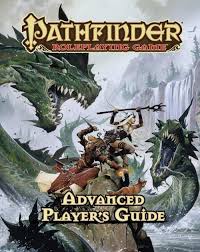
Review: Pathfinder Advanced Player's Guide

The Pathfinder Advanced Player's Guide is awesome.  Everything Paizo does seems to be awesome, and this book is no different.  Unlike 4th Edition's many extra Player's Handbooks, the Advanced Player's Guide adds to and expands the Pathfinder system, not just in adding more of the same kinds of options, but opening up all new options as well.

I want to keep these little reviews short and sweet, so I'm not going to go through everything that lies within this wondrous tome.  (Well, figuratively a tome - I got the PDF).  Rather, I would like to point out three things that are particularly good about the book, and also to discuss any flaws that I find in it.  Again, this won't be a thorough review, more like an impression.

First, the cool:

New Base Class: Alchemist
I really like that Alchemists are one of the new base classes presented by the Pathfinder Advanced Player's Guide.  They are in some ways the Paizo take on the 3.5 Artificer from the Eberron setting, but their focus is not on crafting magical items, but rather on producing alchemical items.

The most exciting application of this ability is creating grenade-like bombs which Alchemists throw in combat. They are walking with loads of potential chemical energy strapped to their backs and around their waists and in their pockets, and during combat, the Alchemist is mixing volatile chemicals on the fly and tossing them on her foes.  That's kind of cool.

Alchemists are also able to create mutagens which they can drink, Dr. Jeckyll style, to modify their abilities in a similar way to how transmutation spells like Fox's Cunning function.  As an Alchemist advances in level, she gets the chance to make Discoveries, improving her abilities, and there is even the Master Chymist Prestige Class, for those who really want to go over the top with their Jeckyll/Hyde issues.

A little note under an Alchemist's special abilities - they all receive the Throw Anything ability.  True, an Alchemist is pretty deadly armed with chemical bombs and mutagens, but I picture a fun scene with an Alchemist in a kitchen, hurling steak knives and pots of boiling water at her foes...

New Equipment
New weapons like the boar spear, sword cane, chakram and double crossbow make their debut in this book, as well as a number of new alchemical items and substances, which  makes a lot of sense with the new Alchemist class.  There is also some truly fantastic artwork depicting the various weapons and suits of armor - far more colorful and evocative than I've seen in other fantasy armories.

What really struck me, though, were the simple new pieces of adventuring gear.  Some things, like earplugs or a periscope, immediately make me wonder how I could build encounters around their use, or as a player, how I could abuse these things to gain an advantage in the game.  There are also items like the astrolabe, bear trap and compass that simply make sense, and can also be of obvious use to adventuring parties.

For those who are less than honest when they go down to the common room at the end of a hard days' dungeon-crawling, there are loaded dice and marked cards.  Overall, a lot of new cool stuff for the inevitable d20 shopping sprees at character creation and between adventurers.

New Prestige Class: Mastery Spy
It has always driven me a bit crazy that in almost all d20 systems, and in most gamist-simulationist combat-focused fantasy RPGs I've ever seen, there are heaps and piles of weaponry, racks of armor, and hundreds of combat abilities, as well as a plethora of magical spells that are aften solely useful in combat.  If I want to play a socially-focused character, a "face" so to speak, however, I'm just out of luck.  I'm going to wander, forlorn from encounter to encounter, making Diplomacy rolls and hoping that, at best, I might make some NPCs like me a little bit more.

Truly sad.

Enter the Master Spy, requiring a number of social skills at up to 7 ranks as well as the Deceitful and Iron Will Feats.  A Master Spy is going to be more socially powerful than other characters of her level, and will become a master of both disguise and deception, able to hide and even alter her alignment.  This is still a combat game, of course, so the Master Spy also periodically gets a bonus to sneak attack damage, and at higher levels, will get the assassin's death attack ability as well as the ability to entirely assume another persona at the highest level, allowing her to even fool the most powerful divination spells.

The problem remains that the Master Spy will not be as powerful or effective in combat as probably any other Prestige Class - that's just a fact of d20 in all of it's forms.  For a social-focused Rogue, however, or possibly a Bard, the Master Spy is a great choice, and I can see a game being built around an embedded Master Spy and her allies helping her from the outside, acting on the information she gathers.

Sneaky Fourth: Hero Points
Under New Rules, the Pathfinder Advanced Player's Guide introduces Hero Points.  These are very similar to my house rules of Action Points from the Eberron setting in 3.5.  Essentially, Hero Points give players more options, as well as some control over when things like character death happen.  I like this in particular because it gets rid of the 'meaningless death' issue in many fantasy RPGs - where the player fails one roll and her character plummets to her death, or is killed by the save-or-die spell, in a way that doesn't further the story whatsoever.  Screw that.

Flaws
A little artistic oversight - the swords on page 261 and 263 are being held in exactly the same way, almost like the artist was using the same sword-holding model for each painting.

Honestly, I am a serious fan of most of what Paizo does, but there aren't many flaws in this superb book.  Most of the 'flaws' I came up with were places where the book didn't go far enough, or where I wished they had included more of the great stuff they are serving up.

Conclusion

4 out of 5 vials of alchemical mutagen

Wednesday, December 1, 2010

2010 NaNoWriMo Reflection

I didn't finish.  I didn't "win" this year.  Not by a long shot.  I got to about 12,000 words and that was as good as I could do.

I can think of a number of reasons that I failed this year.  I had an idea for a story that was already derivative - it was an adaptation of someone else's setting.  Not really fanfic, but derivative enough that I couldn't send it off to publishers in the form it was taking.

It's also possible that I'm simply not a novelist, not a long-form storyteller.  I don't doubt that I'm a storyteller, I just seem to have trouble with novel-length stories.  When I won a few years ago, it was with a story that I thought was pretty cool.  I put this huge amount of November work into it, but then when NaNo was done, I dropped it entirely.  I didn't have the motivation to go back and edit the story.

Is that I'm not a novel writer, or is it that I haven't found the right novel to write?  I don't have any question about whether I am a writer - I write lots of things, not just this blog, and I do a pretty good job of it.  I just wonder whether novels are my thing; will ever be my thing.  I love reading them - there's that at least.

Next year, I'll try it again.  We'll see.  Might just be a matter of a lot of attempts.

Big, big congratulations to everyone who won this year.  See you all next year when I start again with page 1, word 1.

Friday, November 26, 2010

Review: D&D 4th Edition Dark Sun


This is a brief take after my reading of the new campaign setting for 4th Edition Dark Sun.  I have a lot more to say, but I'm trying to be succinct.  If you have particular questions, meet me in the comment thread.

A while ago I got a copy of Dark Sun for 4th Edtion.  I've recently finished reading the complete Prism Pentad for the first time, and might talk about those in another post.  Suffice to say - the quirkly illogic of old-school D&D combined with the brutality of the setting to make an interesting read all around.  Not all of the books are equally good (the 4th one is the worst of the lot, and I might even say skip it) but I read the whole five books, which says something.

I picked up the new 4th Edition Dark Sun Campaign Setting, wondering how 4th Edition's invincible player-characters would combine with the life-is-cheap brutality of Athas.  The answer: you get a lot of 4th Edition wedded to a tiny bit of Dark Sun.

As an implementation of the Dark Sun setting, I think that the new campaign book basically fails.  There is some text about how tough Athas is, but there is very little that actually makes it tough in terms of system.  You have to spend about 5gp a day to live, and if you don't,  you start losing healing surges from lack of water and so on.  Compare this to the most physically strong character in the books, Rkard the Mul, being laid low by having to walk out in the open for three or four days, reduced to a near-dead state, and Athas really loses it's bite.

What I wanted was a grim, desperate land where travel itself, usually at best handled by a montage or a couple skill challenge, could kill you just as readily as the overwhelming collection of murderous, psionic fauna.  What you get is a way to drain 5gp a day out of your pocket.  Which, when a first level encounter might net the party hundreds of gold pieces, has little to no sting.

More than anything else, 4th Edition's take on Dark Sun convinced me that the setting needs it's own system.  D&D is not about being murdered by your harsh environment. It is not about deceit and back-stabbing and political maneuvering.  Both of these things feature prominently in the Prism Pentad books.

Where Dark Sun and 4th Edition overlap in a sweet spot is in gladiatorial combat.  I could see a game based on a cadre of gladiators in Tyr going really well - you get the monster-of-the week phenomenon without needing a lot of explanation, and you get to showcase what 4th Edition does - small-scale tactical combat with kewl powerz.

Once you leave the gladiatorial arena, though, 4th Ed falls apart as an engine for Dark Sun stories.

Rating: 2.5 out of 5 shards of obsidian.

Tuesday, November 16, 2010

Pathfinder: New Spellcasting Feats

I've always thought that Augment Summoning was lonely, and I wanted to see other Feats linked to Spell focus in the other arcane schools.  So here we go - this is a rough sketch, feel free to take and adapt for yourselves:

Augment Dispel
Prerequisite: Spell focus (abjuration)
When making a d20 roll related to dispelling a magical effect, the caster can take 20.

Augment Scrying
Prerequisite: Spell focus (divination)
The duration of all divination spells is extended to concentration +2 rounds where that duration exceeds the listed duration.  For example, scrying lasts for 1 minute/level or concentration +2 rounds, whichever is longer.

Augment Charm
Prerequisite: Spell focus (enchantment)
Charm spells cast by a person with this Feat are more powerful than normal.  Opposed Charisma checks are not required except for the most extreme commands, and the subject of the charm spell will undertake dangerous actions which fall short of suicide.  Lastly, when the charm spell ends, the victim will not have a clear memory of having been magically coerced unless she succeeds at a will save at the spell's normal DC.

Augment Elementalism
Prerequisite: Spell focus (evocation)
Then caster chooses an element in which she specializes.  When she casts evocation spells with this element, the deals +1 damage per damage die rolled.  For example, a fire-specialized elementalist would deal 5d6+5 damage at 9th level when casting fireball.

Augment Figment
Prerequisite: Spell focus (illusion)
Illusionists who take this feat are able to create more persistent figments using spells like Silent Image or Major Image.  These illusions persist even after the caster ceases concentrating on them.  As long as a figment persists, however, the caster loses that spell slot until she dispels the illusion or it is dispelled with a successful will roll due to disbelief.

Augment Undead
Prerequisite: Spell focus (necromancy)
All undead created by a necromancer with this feat are affected as if they are on desecrated ground, including +1 to attack and damage rolls as well as saving throws.  These undead also receive +1 hit point per HD.

Augment Augmentation
Prerequisite: Spell focus (transmutation)
When the transmuter casts a spell which augments the ability of it's target, this bonus is raised by +2.  So, for example, Fox's Cunning increases Intelligence by +6.

Sunday, November 14, 2010

Scott Pilgrim vs the World is one of the worst movies I've ever seen


Here's what I had to say, in brief, about Scott Pilgrim vs the World: 


This was one of the worst movies I've ever seen in my entire life. It was like watching someone play a video game, only more boring. It was sometimes slightly clever. If only it had a story, or a single interesting character, or anything meaningful to say.


I don't remember feeling that detached from a movie in a very long time; possibly ever.  It was totally unengaging.  There's a feeling that I really enjoy, when a movie makes me feel as if I am outside myself, if only for an hour or two, during which it is an engrossing, immersive experience.  Even very bad films can make me feel this way if there is an engaging character, or even a really funny scene.  Anything.


I might have connected to Scott Pilgrim's character, if there was any character there to connect to. But he's kind of a confused-looking place-holder who trudges his way through what passes for a plot.


If there was something genuinely attractive about Ramona Flowers, that might have worked.  But there was hardly a flicker of life in her, but alas.  She was the MacGuffin, and an empty one at that. All I knew about her was that 1. her hair changes color frequently, 2. Scott Pilgrim likes her and 3. she has evil exes.  Nothing about her that wasn't on every promotional poster for the movie.


Where I really checked out, though, was the first battle with the first evil ex.  That was a scene that was so awful that I literally squirmed in my seat with embarrassment for the filmmakers.  I think the fight scene was supposed to resemble a Bollywood musical number.  I've watched a few Bollywood musical numbers, and this piece of tripe was a far cry from them.


There were occasional sight-gags, and I've never seen a movie that was presented in the same way, as an old-school style video-game with level-ups and coins bursting out of downed foes.  That was...slightly clever, I suppose.


But there was no world for Scott Pilgrim to inhabit.  One method would have been literalism - these supernatural music-fueled fights break out.  Another method would have been for the musical fights to be going on in Scott Pilgrim's imagination, with the humorous return to reality after the fact.  The filmmakers went for neither; God knows why.  Rather it was what I experienced as a miasma of imagery - and I mean that in the Dictionary.com sense.


Part of my disappointment was that the movie could have clearly been so much more.  It could have said something.  


It just didn't.


Or, more likely, it did, and I'm the only person I know who didn't get it.


Maybe the graphic novel is good.

Saturday, November 13, 2010

GURPS Midnight: Running A Big Fight in GURPS (Aftermath)

Image from Heroes of Battle, WotC

The Post-mortem

This is the follow-up to my post about setting up for a big tactical battle using modified GURPS rules...

In short, the player-characters kicked ass during the mass tactical combat.  They seemed to have fun and to be engaged in placing their various troops, which is cool because I know two of them aren't usually all that engaged in tactical combats.  They got a kick out of really giving the Orcs a beating.  When the Orcs realized things were going bad, one of the PCs nailed a roll to taunt them into fully attacking, and they were basically pinned down, surrounded, and then rushed by angry villagers who cut them to pieces.

The battle was still significant.  One PC took a javelin in the chest and went down in one hit, as did one of the named NPCs who had been with the PCs since the first session - she almost didn't recover, in fact.

One of the things I really like about GURPS is that having a javelin thrown at you is like "Oh shit!  A javelin!  I might die!"  Instead of D&D, where you might think "Oh, a javelin, 1d6 plus strength modifier damage.  I can eat ten of these, easy."

Anyway, overall, it was a complete success.  As always, in high-lethality tactical combat, planning is everything.

It was also pretty efficient.  A full-scale tactical fight, with combat modifiers for footing and cover and everything, was resolved in under 2 hours, with over 100 combatants and 11 different unit types.  That's quicker than a D&D 4th edition fight can be with a tenth that many participants.

I give the whole experience a B+.  Everyone was engaged, everyone had a thing to do, and the fight was quick and big and bloody.  Good times.

Friday, November 12, 2010

GURPS Midnight: Running A Big Fight in GURPS (Prep)

In my periodic GURPS Midnight game, we are coming to the end of the introductory sessions I've planned to help the players get used to the new system, tweak their characters, and so on.

Last session the PCs ended up rounding up a peasant resistance south of Baden's Bluff, with the able-bodied people of three villages fortifying and preparing to fight against a group of a couple dozen Orcs and some Goblin slavers.  The PCs came up with a plan, and this session, we find out how the plan works.

First I'll talk about what is involved, the situation, and then I'll go through how I represented it using GURPS.  Lastly, I'll post a report on how the game works out.

The setup

Here's what the prepped table looks like:


On the far side of the table, where I'll be sitting, are the Orcs.  I'm using colored cubes that I found at a craft store to represent the units, as well as the D&D minis that I have that fit.  The red cubes are extra Orcs.

On the near side are the five PCs looking lonely and heroic facing the Orcs - I set it up that way just to set the scene.  The PCs are the heavy-hitters in this fight - the peasants they're leading aren't soldiers, they're villagers the PCs have convinced to join them.

The colored cubes at the near side of the table are for the PCs to place - those are their "troops".  They're stacked in descending order of 'power' where this fight is concerned.

Blue cubes are the toughest villagers: the smith and his two burly sons, two people who have hatchets, and two people who have bows.  Remember, all weapons are illegal, on pain of death, in the Midnight setting.

Orange cubes are the rest of the villagers who have spears - the village they are defending, Dorn Hill, is a village that happened to have a comparatively large amount of contraband weapons.

Green cubes are the villagers who have slings - not a lot of damage, but they have the advantage of being able to hit the Orcs without being hit themselves.

Purple cubes are the villagers who have large knives and are willing to fight with them (given that most families have a knife between them, even though they're technically illegal, because it's a ubiquitous tool)

Yellow cubes are the villagers who are willing to fight, but don't have anything more dangerous than farm tools - grain flails, wooden pitchforks and quarterstaves.


The system hack


I'd like every villager death to be dramatic, and every Orc injury to be hard-won, so I want to treat each interaction with it's own die-roll, possibly hand-waiving if things begin to drag.  But I want every death to hurt.  This battle may very well not go in the PCs' favor, and the characters have never led troops before.

For the purposes of simplifying the battle, I am assuming everyone is using an All-Out Attack maneuver, as per the GURPS rules - the weaker ones, using knives and farm tools, taking a +2 to damage, and the others taking the +4 to attack rolls.  This lets me ignore defenses - it's hard to parry with a knife or a hammer anyway.

I'm assuming the Orcs are really excited at the chance for a real, pitched battle where mostly their job is terrorizing unarmed villagers.

I also simplified damage: each hit from an Orc will take out the villager they hit.  Villagers don't have more armor than layering the clothing they have, and the Orcs are wielding military weaponry with deadly skill.  Each hit from a villager wounds the Orc in question, and a second hit will take that Orc out.  Taken out means downed, unable to move well, and possibly going into shock, not dead unless the person is left without help.

On the fly, I'll try to take penalties and bonuses into account - mostly penalties for things like slingers on rooftops (bad footing -2) or Orcs and villagers trying to fight across the debris barriers the villagers put up to block the road at two points.

I am also taking morale into account.  I need to double check the GURPS morale rules, if I can find them, but I'm assuming the Orcs will make a morale check after losing 20% of their force and the villagers will have to after losing 10% of their force - they're not used to seeing their friends and family die around them.

Morale will be a collective Will roll and a Leadership roll from the leader of each force (an Orc veteran on one side and a PC on the other side).  If both succeed, they force is fine.  If only one succeeds, the force is stalled.  If both fail, the force withdraws.  A second failure means they panic and break.


The PC plan and the wild-card

One of the PCs is a spellcaster, using a lot of Mind Control magic.  The PCs' plan hinges on him using a Panic spell to make groups of the Orcs run away, making them unable to defend themselves and letting villagers injure them as they flee.  He probably won't have the energy to do this more than a couple times.  At the very least, it allows the PCs to use his magic-induced panic as cover.

It remains to be seen whether the PCs will set things up to be really able to take advantage of this tactic.

***

We'll see how things work out - I'll be trying this during our game tomorrow.

Thursday, November 4, 2010

Reflections on Gary Gygax and Dangerous Journeys


This is the might-have-been cover for Gary Gygax's game, from an advertisement in White Wolf, before the name was changed because TSR claimed that Dangerous Dimensions was too close to Dungeons & Dragons.  Next to it is the cover of the book that I picked up as a 12-year-old kid, when it was hot of the presses in 1992.

Unfortunately, day 4 of Con on the Cob ended with my wife rolling her ankle in the parking lot, so the fun ended on Day 3.  No question, though, Con on the Cob is a lot of fun, and I want to make it a regular part of however many autumns I spend in this area.

I had the change to have an interesting conversation with a woman who was at the convention, running one of those traveling stands with rpg books in crates, jewelry, odds and ends, old board games, that kind of thing.  They're the Hell on Wheels Traveling Hobby Shop, and they're at something like 40+ conventions a year.

I picked up a copy of Epic of Aerth, the last book I was looking for from Gary Gygax's Dangerous Journeys game.  It is the setting book for Dangerous Journeys, kind of a re-imagined alternate history, where not only magic but also magical locations, like the hollow earth and Lemuria and Atlantis, are real.  Like most of the things he wrote, Epic of Aerth represents a huge amount of research

In talking to the woman who sold me the book, I learned that Hell on Wheels came across a number of signed copies of old Dangerous Journeys books.  When Gary Gygax died, so her story went, his widow asked that the old books that didn't sell that year be destroyed.  At Gen Con, Hell on Wheels decided to buy all of the remaining books and re-sell them.  Apparently, I just missed getting a signed copy.

As I've mentioned before, Dangerous Journeys was the first rpg I ever picked up and played.  I found it wandering the Fantasy and Sci-Fi section of the local bookstore.  After Gary Gygax was no longer working with TSR on D&D, Dangerous Journeys is the game he wrote.  It never seems to have caught on, though.  Most people I talk to have never heard of it, and I almost never see it mentioned, even in the gaming blogosphere, which is often obsessed with obscure games.  Of course, it makes sense that not a lot of copies of the game are out there, since TSR sued Gygax as soon as Dangerous Journeys was published, won rights to the game, and then permanently shelved it.

Dick move.

I've always thought it was interesting that, left to his own devices, not collaborating with anyone, Dangerous Journeys is what he came up with.  It is unlike most of his modules - very down-to-earth, in a sense, with far more consideration for real-world history and societies than ever existed in any edition of Dungeons and Dragons.  Frankly, in a lot of ways, Dangerous Journeys is a better game than D&D, and if it was in its 4th edition, I bet it would still be a hell of a game.

I got to run Dangerous Journeys once, at Gamescape North in San Rafael, for a game night held there.  It took a tremendously long time to create the characters for the scenario, but the game, it still plays just fine.

Saturday, October 23, 2010

Another Star Wars Trilogy?


Honestly, at this point, in light of the load of feces that was the 3 prequel films, I read this news with a strong sense of dread.  However, there is a rumor out there that Lucas out at Skywalker Ranch is working on a series of sequel movies to the original films - episodes 7-9 or even episodes 10-12.  They will purportedly take place 100 to 1000 years after the originals, and will not focus on the Skywalkers.

If George Lucas writes these sequels themselves, I will come out and say right now that they will be complete and utter garbage - one more gobbet of spit in the face of ever Star Wars fan.

On the other hand, maybe he learned his lesson and will hire a talented writing team to put together some well-written scripts, and new classics will be born.

I'm not betting on it, though.  I think that if the rumor is true, he'll write them himself, and they will be another abomination.

Wednesday, October 20, 2010

Gaming Geeks Unite! DriveThru RPG Pakistan Flood Relief

It's the talk of the Interwebs - DriveThru RPG is offering a bundle of PDF products, the sale of which will go to support Doctors Without Borders and the victims of the recent massive Pakistan flood.

Just glancing down the list of products makes it clear that this is an unbelievable amount of gaming goodness for the listed price of $25.  Even if it wasn't philanthropy, it would be a hell of a deal.

This isn't just a load of inexpensive peripherals - there are plenty of full games like Contenders, Don't Rest Your Head, Dragon Warriors, Exalted Second Edition, Fear Itself, Hot War, Icons, Spycraft 2.0, Starblazer Adventures, Time and Temp, Wild Talents 2nd Edition...

A total value of $730 altogether.  For $25!

CCT Journal 15: Character Death

I killed two people last night. The end of the second module in this adventure path is a raid on the temple of the cult of Urgathoa that has been spreading the plague Blood Veil in the city of Korvosa. It is a dungeon crawl that follows many of the normal rules of dungeon crawls, which are stupid. I changed those stupid rules and it resulted in character deaths.

The first stupid rule is that bad guys wait patiently in the next room despite the sounds of pitched battle echoing through the whole dungeon. They do not come join other battles, organize, strategize, utilize choke points or any of that stuff. I changed this rule. When the party began raiding the temple and set off the alarm, the inhabitants grouped up, prepared by casting buffs, developed a plan and... well the PC's nearly got killed in the first encounter.

The second stupid rule, is a subset of the first, which is that you can take as much time as you want getting through a dungeon, including stopping to rest and recover spells. I changed this rule. I made sure it was clear there was a deadline. Lives needed saving. Bad guys were plotting and delays would mean heavy costs. I simply can't stand the idea that the villain is sitting in the last room of the dungeon with their evil plan nearly complete just waiting for the heroes to walk in before they go through with it. The result was that a string of encounters that would have been manageable one by one with breaks in between became an unbearable combination of mayhem.

Two player characters died.

The first was obliterated by a Leukodaemon's breath of flies - riddled with holes and eaten by maggots before their eyes. The second was crushed by the deformed claw of a Daughter of Urgathoa, already crippled by a stew of noxious diseases.

Neither death was planned or intended, though I'm always prepared for the possibility of character death. Since D&D characters are in pitched battle on a daily basis it can be a challenge to make a death memorable, but I think these worked out well, occurring as they did at the very end of a story arc and in appropriately gruesome ways. It was made more memorable by the fact that the party emerged victorious (barely), saving the city from certain doom.

Normally in D&D character death is a minor obstacle. You just need a diamond and a sufficiently high-level Cleric and voila! Respawn. But I think that is a stupid rule too. I don't think an epic adventure story should feel like Halo. So I changed that rule. Resurrection is still possible, but it is costly. Something significant and permanent changes about your character when you die and choose to be revived with magic. This change is both aesthetic and mechanical and should provoke an attendant response in roleplaying.

For each character it is different. Both characters chose last night to be resurrected. It was dramatic for both of them, but one of the characters who died last night was reborn in fire, her skin now glassy and black like a hunk of obsidian. Always an Oracle of Flame, her ordeal has deepened her relationship to the element. Now she hears voices in the fire, speaking. She lost some experience, and will have to readjust to her new circumstances, but she is back. Alive and able to continue the story. That kind of stuff makes character death, and resurrection, satisfying.

Friday, October 15, 2010

Con on the Cob 2010 Day 2

Being stupid, I forgot to take any new pictures of my second day at the Con.  I did get to meet Mike B in person, however, and to play in a demo of the Dark Golden Age, wherein we discovered the entrance to the Library of Yemuria, disabled some of it's defenses, and of course killed the librarian, who had become a magowight.

On the drive home, the fall weather was in rare form, and we got to see the most spectacular rainbow I've seen in a long time.  Pam let me know that this kind of thing was run-of-the-mill in Alaska, but never having been to Alaska, this was still pretty damn nice.  As expected, my iPhone doesn't do the rainbow justice, but still:

Thursday, October 14, 2010

Con on the Cob 2010 Day 1


So, today is day 1 of Con on the Cob 2010.  I went in and got my badge and some literature that I'll take the time to look over when I get a chance.  It's interesting being at CotC when Origins was my first (and second) gaming convention.  The difference in scale is tremendous.  Right now they're mostly setting up - there will be a tour led by Andy Hopp at 3pm that I'm going to try to get into, and my bySwarm cohort Mike B is likely to arrive at the Con around that time as well.

The Con itself is at a small conference center in Hudson, OH, which is currently nestled in a tangle of construction and detours that made actually getting there, having never been, a little challenging.  I also seem to be being followed around by cold, diagonal rain.

Today is mostly not about the Con - today is mostly about me relaxing and not having to work.  I need to pick my wife up at 5 from work back in Wooster, so we won't be there for the festivities tonight.  I'd rather this was not the case, but wife > gaming.  So I'll probably have time to take the tour with Andy, get some pics of how things look, hopefully say hi to Mike B, and then race home to collect mi mujer.

Here's the entrance before things get going:


Here's Andy Hopp welcoming us newcomers.  He's probably among the top 10 nicest people in the entire world.


And here's Sean Patrick Fannon, the guest of honor who got the most time on the mic.  I'm hoping to get into a Shaintar game he's running this year.

Wednesday, October 13, 2010

CCT Journal 14: Jumping the Rails

We're playing a published adventure module and everyone knows it. My players are cooperative. They are diving into the storyline and as long as we work together the "rails" of the adventure are fairly invisible beneath us. But sometimes even groups with the best of intentions feel constrained by the narrative of an adventure. Honestly, sometimes the players are better writers than the GM or designers who wrote the plot in the first place.

A couple such instances have popped up in my last two sessions of Curse of the Crimson Throne. Situations were written into the module which while standard D&D fare put the characters at a definite disadvantage and required a bit of willing blindness from the players. My players rightfully started asking questions - why do we have to do it that way? Wouldn't it make more sense if? I was forced to concede that their way did indeed make more sense even though it presented some problems for me in terms of running the adventure as written.

When Doug runs a game the situations are almost always malleable. His NPC's react to what the players decide to do. It is character driven all the way. My games are more story driven. There are stronger rails for the PC's to follow. But no matter what style of GM you are, there are times where you have to be willing to jump the rails. The goal of the game is fun and you will compromise your players fun if you never cooperate with them and their good ideas - even when those ideas upset the applecart a bit.

So when Hrungar the Dwarf started talking sensibly about luring the villain out of his highly defensible lair with a rather cunning ploy and leading him into an ambush - even though it was going to completely change a whole series of encounters, radically reduce the threat to the party and actually skip over some important information they needed - I went along with it. The ploy was clever enough, in my opinion, to actually trick an intelligent villain and you couldn't argue the basic point that rushing headlong into the bad guy's lair, though a staple of D&D, is pretty stupid. I rewarded the players by letting their clever ambush succeed (and then I rewarded them with a bit of bonus XP as well to make up for encounters they missed by not charging in). I found alternate ways to make the encounter exciting - this was an intelligent villain after all, he didn't just walk into a trap without some contingency plan. And I delivered the important information they needed through a different mechanism - instead of overhearing chatty guards they found notes on the villain's person.

Sometimes this happens and the players have no idea they've actually jumped the rails - that's good. It means you adapted very smoothly and they couldn't tell the difference between planned encounters and improvised ones. Sometimes you jump the rails and the players are fully aware, as in my situation the other night. This is also good. It lets the players know that the world is responsive to their decisions and gives them incentive to cooperate with the plot in the future since they won't feel constrained by it. You enhance the illusion that they are following the story by choice, which is a valuable illusion for the sake of fun.

Monday, October 4, 2010

Rant: I Hate Puzzles

The most recent Penny Arcade comic about an upcoming Myst movie brought this to mind.  It is one of my gamer geek disconnects, perhaps, but I hate puzzles.  I hate them so much.  Only someone loudly answering a cellphone call pulls me out of a narrative faster.  How often do we encounter intricate puzzles in our lives, where we have to move levers and pull knobs and push boxes around on the ground or whatever before we can continue?

Never, that's how often.

Puzzles in a roleplaying game, or a story, particularly arbitrary ones of the Myst-slash-Undermountain kind, are an assault on verisimilitude, guns blazing.  Hey, I know, how about if I solve this delicate puzzle with a sledgehammer, and let the puzzle-fans pick up the shiny little pieces and reassemble them while I continue on my way doing things that are interesting?

You can tell how much of an affront puzzles are in a narrative of any kind by the degree of mental gymnastics one has to undergo in order to justify them.  Think of the Saw movies.  How hard to we have to work to get to the point where we get drawn into a Saw movie?  You have to have this absurd serial-killer torture-addict with apparently unlimited resources who leaves no forensic evidence whatsoever as to who he might be, even though he builds rooms full of machinery and puts people's heads in bear traps and stuff.

Every situation where you have some stupid puzzle standing in the way of your fun, it has to be justified, and almost always justified by positing an arbitrary-evil-crazy-genius.  And yes, I suppose if you have no material limitations, and a number of crazy evil geniuses running around without supervision, you may very well end up with some puzzles that get in the way of your life.

You can, even in that unlikely scenario, still deal with them principally by way of shouting and bludgeoning until their riven intricacies are laid bare.  Then, maybe a crowbar, and you're done.

I'm sorry - the crazy arbitrary one is the person who thinks that a narrative is improved by a frustration-manufacturing Rube-Goldberg machine standing between me and moving forward with the story for God's sake.

Now, I hear the argument that Myst has this really amazing story behind it.  That is exactly the problem - the story is in the background, and meanwhile I'm pulling levers and pushing buttons and rapidly losing interest.  Not only does a puzzle have to justify itself, but it is also basically self-contained.  An extensive, trap-ridden colored-block puzzle is functionally identically to a door with knob on it that you turn to open it.  All that time and effort you spent on the colored-block puzzle was basically masturbatory.  I'm as much a fan of masturbation as anyone, but that just isn't my style.

Thursday, September 23, 2010

D&D 4th Edition - Character Creation + Hacks Part 2

Long ago, in ancient times, I posted about how I handled 4th Edition D&D character creation with my home group.  Since then, a fine gentleman created a document for the method that I described.  It is available for download here.

It's a good document and the method worked, for me at least.

Wednesday, September 22, 2010

CCT Journal 14: Winning

In the midst of my drive to continually challenge my players and create tension and drama by exacting costs out of their characters it is important not to forget a basic point: people like to win. No matter how dire things appear for the PC's underneath it all the odds of them actually losing are close to zero over the long haul. The miracle is that they manage to suspend their disbelief well enough that they actually fear losing given their near perfect batting average.

Once in a while it is important to throw in a little setback, to help them keep that enjoyable fear going, but it is equally crucial to serve up a big slice of victory now and again. I don't just mean the usual "we survived, the monsters didn't" sort of victory. I mean a genuine old-fashioned ass-handing destruction of a recurring antagonist. After all, this is why we went to the trouble of creating the antagonist in the first place - so it could be painfully dismantled.

When it is time for the PC's to have a meaningful victory it is time to tee it up for a nice homer. Now is not the time to throw some crazy curveball that confuses and frustrates them. The players should have seen the surprises and be able to anticipate them. They should, in fact, know how to counter the antagonist's strength and exploit their weaknesses to get the most joy out of winning in a convincing fashion. Lavish their successes with evocative description and pass over their failures with barely a comment to leave the impression that they're too cool for school. Create moments that scream for cheesy one-liners.

Like most aspects of storytelling there is a rhythm to this. Decisive victories can't happen too often or you rob them of their power. Nor are they really climactic material. At the climax everything is at stake and the cost is high. The kind of winning I am talking about here is good clean fun - nobody gets hurt that doesn't deserve it. Used correctly winning is one of the most addictive rewards in gaming. Who doesn't like kicking ass and taking names?

Monday, September 13, 2010

The Lich King is Dead

Gamescape Northerners finally got the bastard. Meet your new Kingslayers:


Adirah, Arianwen, Bellatrixa, Bellazune, Etspiritu, Hyphae, Letlia, Makat, Miko, Moradan

Wednesday, September 8, 2010

CCT Journal 13: Hating the Baddies

There are many ways to motivate players. Loot motivates some players. Experience and leveling motivates most players. Other kinds of rewards are plentiful - titles, acclaim, success, narrative focus, resolving story arcs - the list is endless. Punishment also works as motivation. You can punish players for making bad choices in the game by withholding rewards mentioned above, or more subtly boring them by not providing expected stimulus. The easiest way to keep players "on the rails" as it were is to make everywhere off the rails dreadfully dull.

One of the most rewarding ways, from a GM's perspective, for a player to find motivation is by hating the villains. When a nasty NPC you've created and run succeeds in earning the players everlasting enmity... it is pure joy.

It is easier said than done. Most villain schtick is so beyond-cliche that players hardly waste the energy yawning. Loot and experience are easy and quantifiable methods of motivation. Whereas a roleplaying motivation like this requires several steps.

#1 Make them care about themselves. This right here is the major reason attempts to motivate players by giving them a juicy bad-guy often short circuit. There is nothing the GM can do to force players to care about their own characters. You can encourage it. You can ask questions. You can provide gentle guidance and set a positive example in how to create fully-rounded interesting characters, but the player has to decide all on their lonesome at the end of the day to care. This isn't entirely true. The GM can also help lubricate this process by giving the players success. If they taste success they will become attached to the process of attaining that success to which their character is the vehicle. Time, familiarity, and positive reinforcement will eventually help a player come to care about their character even if they didn't at first.

#2 Make them care about others. If your player cares about their character this next step isn't so hard. The same process of time, familiarity, and positive reinforcement will work here. Want the players to care about an NPC - have the NPC make them laugh and provide them with rewards. The more subtly this is done the more effective it will be, but even a ham-fisted "this is the helpful NPC" approach will have some effect.

#3 Threaten the object of their affection. This part is where the cliche kicks in. Everyone has seen the Green Goblin dangle Mary Jane a million times. Cliche's are popular because they work, but you have to be creative about dressing them up a bit to hide their predictable nature. Try not to go after the obvious target (girlfriends, parents, village where the hero grew up etc...). Go for something a little more personal and unexpected - the Paladin's honorable reputation, the thief's good-standing in the guild, the helpful magistrate who always looked the other way. Even better if you go for something that players will usually assume is off limits - make the Dwarven womanizer impotent, the cleric's deity suddenly doubt his faith.

#4 Set them up for success. Help the party develop a good plan and convince them they will thwart the baddie's intentions. Give them allies, and every reason to believe they will be successful. Ensure the plan goes smoothly. Give them the advantage in a combat. Make the villain express fear, doubt, or pain so the villain seems weak. Don't overdo it. This is not the time to be melodramatic or the players will catch on to the trick. Just give the normal signals you give when the players are about to win a combat.

#5 Drop the floor out from under them. Make the villain win in an agonizing irreversible way. At the last minute the bad guy completes the sacrifice and permanently destroys the soul of the helpful cohort. Then make the villain get away before the players can take revenge.

#6 Let them stew. It is important you do not reward them immediately with any opportunities for cathartic revenge. Their hatred of the baddie really blossoms in this step right here as they explore different ways to rectify their loss and find each avenue a dead end. It is possible to repeat steps 3 through 6 several times building up a bigger hatred, but it is inadvisable to do so too many times in succession. 2-3 times is probably a maximum. Eventually players catch on and either stop caring or just redirect their frustration at the GM.

#7 Threaten them directly. After proving that the villain is capable and willing to hurt the players indirectly and giving them time to build up a good hatecrush, let them know the villain is coming after them directly. If you've done your job well the threat will be believable and players will be cautious, but also excited about finally getting their cathartic confrontation.

#8 Reveal the flaw. As opposed to step #4 where you misled the players into believing they would triumph, in the final confrontation you should encourage them to believe that history is about to repeat itself and they will once more lose to the villain. Then, in a reversal of step #5 let the players in on a secret - the flaw in the villains plan, the blindspot, the achilles heal. Present it for them to take advantage of. Let them pounce and win.

They will never love hating an imaginary character so much.

Friday, September 3, 2010

CCT Journal 12: Organizations

One thing that I've noticed about this adventure module, possibly because it is an urban campaign, is that it is drenched in organizations and factions. Due to the characters my players have created we even ended up with a few that weren't written in by the designers. Here is a list:

Military Organizations
Korvosan City Guard
Sable Company Marines
Order of the Nail
Grey Maidens

Religious Organizations
Temple of Abadar
Temple of Asmodeus
Temple of Saranrae
Temple of Pharasma

Secret Evil Organizations
Cult of Urgathoa
Red Mantis
Followers of Zon Kuthon

Korvosa Specific Organizations
Queen's Physicians
Cerulean Society
Arkona Family
The Acadamae
Eel's End
Orisini Academy of Fencing
Gaedren Lamm's Gang
Cow Hammer Boys
Girrigz' Wererat Army

Varisian & Shoanti Groups
Sczarni Thugs
Kasanda Foxglove's Family
Skoan Quah
Sklar Quah
Lyrune Quah

Others
Steelheart Dwarven Clan
Various Orc Tribes

I'm sure that list is incomplete. It's a lot of different groups for the players to keep track of and try to figure out how they are related. The good aspect of this is that the world definitely feels multi-layered and complex. They have been drawn into quite a bit of intrigue. On the down side they also seem to get pulled in so many directions at once it is distracting. I have tried to mitigate this by closely aligning certain NPC's and organizations with each other so that they are essentially interchangeable in terms of their plot function. You lose a little of the distinctiveness of the different groups, but for sanity's sake it is necessary. The best thing about this huge array of organizations is that the players really feel like they are having an impact on the world, when their actions shift the power-structure or even bring an end to a particular organization. When an entire criminal ring collapses or a whole tribe changes their attitude toward you it feels epic.

GURPS Midnight - Sample Foes

Having worked up racial templates, I applied them to sample foes in order to get an idea of how they played out, and to provide me with go-to baddies to throw at the PCs.  Again, I've tweaked all of these a great deal, and am open to changing them further, but the game is tomorrow, so I'm posting what I'm going with in case it is of interest (I've had a couple tell me it is) and I'm happy to get comments, questions and that sort of thing.

You'll notice a few notes to myself here and there, and the fact that the Asterax is blank - just haven't gotten that far yet.

I'm not too worried about players reading this - I'm pretty sure only a couple of my players might even read this blog, and I also think they're the kinds of players who wouldn't abuse the knowledge.  Also, I guess the advantage with GURPS is that everything is pretty logical - there aren't really surprise weaknesses or strengths here.  If you're facing a Goblin or an Uruk, you're pretty much facing what you'd expect - at least, that's the idea.


Samples

Recent Villager Ungral [5pts]
ST 13, DX 9, IQ 6, HT 11
-40 Ungral
Hard to Kill +5
Hard to Subdue +5
Injury Tolerance: Unliving (no extra from cutting and piercing)
Unfazeable
Brawling 9; 1dcr
All-out attack: Brawling 13 1dcr; Brawling 9 + 9 1dcr; Brawling 9 1d+2cr
Move 5; Parry (unarmed) 7
They have a Perception of 6 on average, meaning there can be lots of tense scenes where the PCs are sneaking amongst the Ungrals, hoping they aren't spotted

Recent Soldier Ungral [30pts]
ST 14, DX 10, IQ 5, HT 12
-40 Ungral
Hard to Kill +5
Hard to Subdue +5
Injury Tolerance: Unliving (no extra from cutting and piercing)
Unfazeable
Brawling 10; 1dcr
All-out attack: Brawling 14 1dcr; Brawling 10 + 10 1dcr; Brawling 10 1d+2cr
Move 5; Parry (unarmed) 8

Orc Grunt [24pts]
10 ST 12, DX 10, IQ 9, HT 11
17 Orc
-5 Duty
-15 Psychological disadvantage
Move 4.25, Parry 8, Dodge 7; DR 2
21 Axe/Mace 11, Running 11, Scrounging 11, Spear 11, Survival 10, Throwing 10
Axe 11 2d cut (unbalanced) OR Spear 11 1d+2 imp, Javelin 1d+1 imp, Leather armor
Light encumbrance

Orc Veteran [50pts]
10 ST 13, DX 10, IQ 9, HT 11
17 Orc
15 Combat Reflexes
5 Status +1
-10 Duty
-15 Psychological disadvantage
Move 3.25, Block 12, Dodge 7, Parry 10; DR 3/5
28 Axe/Mace 11, Running 11, Scrounging 11, Shield 12, Spear 11, Survival 10, Sword 11
Vardatch 11 2d+1 cut, Medium Shield, Chainmail armor
Medium encumbrance

Orc Champion [77pts]
20 ST 13, DX 10, IQ 9, HT 12
17 Orc
15 Combat Reflexes
10 Status +2
-10 Duty
-15 Psychological disadvantage
Move 3.5, Block 12, Dodge 7, Parry 10; DR 3/5
30 Axe/Mace 11, Intimidation 9, Leadership 9, Running 11, Scrounging 11, Shield 12, Spear 11, Survival 10, Sword 11
Vardatch 11 2d+1 cut, Medium Shield, Chainmail armor
Medium encumbrance


Orc Warband Leader [102pts]
40 ST 13, DX 10, IQ 10, HT 12
17 Orc
15 Combat Reflexes
5 DR +1
15 Status +3
10 Comfortable
-15 Duty
-15 Psychological disadvantage
Move 3.5, Block 12, Dodge 7, Parry 10; DR 7
30 Axe/Mace 11, Intimidation 10, Leadership 10, Running 11, Scrounging 12, Shield 12, Spear 11, Survival 11, Sword 11
Vardatch 11 2d+2 cut, Medium Shield, Plate armor
Medium encumbrance

Orc Mother/Lesser Priestess [74pts]
20 ST 11, DX 10, IQ 10, HT 11
17 Orc
10 Comfortable
5 DR +1
10 Power Investiture +1
10 Status +2
-5 Disciplines of Faith
-15 Duty
-15 Psychological disadvantage
18 Leadership 10, Religious Ritual 11, Staff 10, Theology 10
24 Detect Magic 11, Fear 11, Lend Energy 11, Lend Vitality 11, Minor Healing 11, Sense Emotion 11
Move 4.5, Dodge 7, Parry 10; DR 1
Staff 10 1d+3cr
Light encumbrance

Orc Mother/Priestess [107pts]
20 ST 11, DX 9, IQ 10, HT 11
17 Orc
20 Wealthy
5 DR +1
20 Power Investiture +2
15 Status +3
-5 Disciplines of Faith
-15 Duty
-15 Psychological disadvantage
18 Leadership 10, Religious Ritual 11, Staff 9, Theology 10
48 Death Vision 12, Fear 12, Final Rest 12, Lend Energy 12, Lend Vitality 12, Minor Healing 12, Major Healing 11, Sense Emotion 12, Sense Spirit 12, Steal Energy 12, Steal Vitality 12, Turn Zombie 12, Zombie 12
Move 4, Dodge 7, Parry 9; DR 3
Staff 10 1d+3cr; Leather armor
Light encumbrance

Uruk/Ogre/Troll Shock Trooper [74pts]
40 ST 18, DX 9, IQ 8, HT 14
27 Uruk (Size +1)
5 DR +1
10 High Pain Threshold
5 Status +1
12 Intimidation 9, Survival 9, Two-handed Axe/Mace 10
Move 4.75, Dodge 5, Parry 8; DR 4/6
War club 10 3d+2cr; Chainmail armor
Medium encumberance
-10 Duty
-15 Psychological disadvantage

Goblin Worker [21pts]
10 ST 9, DX 11, IQ 10, HT 11
20 Goblin
16 Animal Handling 11, Knife 12, Laborer 11, Scrounging 12
Move 4.25, Dodge 9, Parry 7
Knife 1d-1 cut
-10 Duty
-15 Psychological Disadvantage

Goblin Scout/Archer [43pts]
30 ST 9, DX 12, IQ 10, HT 10
20 Goblin
18 Bow 12, Knife 13, Scrounging 12, Survival 11, Tracking 10
Move 3.5, Dodge 8, Parry 7, DR 2
Regular Bow 12 1d imp, Knife 13 1d-1 cut; Leather armor
Light Encumbrance
-10 Duty
-15 Psychological Disadvantage

Goblin Slaver [50pts]
20 ST 10, DX 11, IQ 10, HT 10
20 Goblin
5 Status +1
20 Axe/mace 12, Crossbow 12, Knife 12, Haggling 11, Intimidation 11, Merchant 11
Move 3.25, Dodge 8, Parry 9, DR 2
Bludgeon 12 1d+2cr, Crossbow 12 1d+2imp, Leather armor
Light Encumberance
-15 Psychological Disadvantage

Lesser Legate [49pts]
10 ST 9, DX 10, IQ 11, HT 10
5 Clerical Investment +1
10 Comfortable
10 Power Investiture +1
5 Status +1
-5 Disciplines of faith
-10 Duty
-15 Psychological Disadvantage
21 Axe/Mace 10, Intimidation 11, Leadership 11, Religious Ritual 11, Shield 11, Theology 11
Detect Magic 11, Fear 11, Identify Spell 11, Light 11, Seek Magic 11, Sense Emotion 11, Sense Foes 11, Sense Mana 11, Sense Spirit 11, 
Move 3.75, Block 12, Dodge 7, Parry 9; DR 3/5
Mace 10 1d+1cr, Light Shield 11, Chainmail
Medium Encumbrance

Soldier Legate [79pts]
20 ST 11, DX 10, IQ 10, HT 11
5 Clerical Investment +2
10 Comfortable
20 Power Investiture +2
10 Status +2
-5 Disciplines of faith
-10 Duty
-15 Psychological Disadvantage
23 Axe/Mace 11, Intimidation 10, Leadership 10, Religious Ritual 10, Shield 11, Theology 10
16 Detect Magic 11, Fear 11, Identify Spell 11, Lend Energy 11, Lend Vitality 11, Lesser Healing 11, Light 11, Seek Magic 11, 
Move 3.75, Block 12, Dodge 7, Parry 9; DR 3/5
Mace 10 1d+3cr, Light Shield 12, Chainmail
Medium Encumbrance

Greater Legate [117pts]
20 ST 10, DX 10, IQ 11, HT 10
15 Clerical Investment +3
20 Wealthy
30 Power Investiture +3
15 Status +3
-5 Disciplines of faith
-10 Duty
-15 Psychological Disadvantage
21 Axe/Mace 10, Intimidation 11, Leadership 11, Religious Ritual 11, Shield 11, Theology 11
26 Detect Magic 13, Fear 13, Identify Spell 13, Lesser Healing 13, Lend Energy 13, Lend Vitality 13, Light 13, Panic 13, Seek Magic 13, Sense Emotion 13, Sense Foes 13, Sense Mana 13, Sense Spirit 13, 
Move 3.75, Block 12, Dodge 7, Parry 9; DR 3/5
Mace 10 1d+1cr, Light Shield 11, Chainmail
Medium Encumbrance

Astirax [ ]