Showing posts with label Game Reviews. Show all posts

Sunday, November 13, 2011

GASPCon - Pittsburgh 2011


I'm wirting this sitting in the hotel room I'm sharing with Pete Figtree at GASPCon in Pittsburgh.  So far, it's been awesome.  I've already had a chance to play Warhammer Fantasy Roleplay 3rd Edition as well as Kenneth Hite's Bookhounds of London playset for Fiasco.  Later that night, I got a chance to play Dread, and then the next day, I got a chance to play both Summoner Wars and then Ganakagok.  I just want to briefly give my impressions of each.

Warhammer Fantasy Roleplay 3rd Edition


I haven't played any other edition of WFRPG, nor have I ever played any of the minis games, the Warhammer 40k RPGs, or the MMO.  Warhammer is not in my geek curriculum vitae, as it were.  That being said, while working at Gamescape North I did get a chance to go through the WFRPG box when it arrived in the store and I loved the design of the game.  I love the custom dice (like Descent, but with a bit more depth and complexity) and I love the card that players can slot tactics into so that other player-characters can use them.

The scenario was pretty straightforward - a group of Dwarves are going to Blackfire Pass to recover an artifact and find out what happened to their brother.  I played a Trollslayer and had fun splitting foes in half with one shot and wringing blood and ale from my beard.


Fiasco


Kenneth Hite being awesome aside, Fiasco was a lot of fun, but I can see how it could be a lot more fun.  My group was good people, but three of us had never played Fiasco, and two of the players were clearly having trouble with framing scenes and reacting to things and knowing what it is they were supposed to do when confronted with a challenge.  These are new skills for most gamers, though, so no worries.  I got to play Aleister Crowley, and I ended up trying to make amends for all the terrible things I'd done by feeding myself to a huge demonic cat-beast.


Dread


The triumph of Dread, in this session, was that even though our GM wasn't doing a very good job, there were still plenty of moments of tension at the table.  (Granted, it was a very late game, and maybe he was just off his mojo, who knows?)  This would never have been the case with another system, period, and I really see the strength of the simple but brilliant insight of using Jenga as a resolution system for a horror rpg.  It definitely made me hesitant about doing anything risky, and at one point I was very tempted to push the tower over and sacrifice my character to save another character's life.  At that point, though, it looked like we were going to make it out of the scenario alive - and we did.


Summoner Wars


I never got into Magic or any other CCGs or TCGs.  I feel like, with a lot of them, there are so many sets and so much complexity that the game becomes a race to see who can find the most rules exploits.  This appeals to some people but not really to me.  I did enjoy Summoner Wars very much, though.  I like that the decks are pretty simple, and that they are pre-built.  I played the Cave Goblin army, and the tactic was simple enough - summon out zero-cost fighters and slingers, swarm my opponent, and use event cards to let them gang up on single units.  I'm sure that the game is less fun when you aren't beating the crap out of Pete Figtree, but still, a cool game.


Ganakagok


Ganakagok is one of my new favorite games.  The Game Chef event that gave rise to Polaris, Ganakagok and Mountain Witch must have been some kind of celestial event that rent the world open and let creativity pour out into game designers.  Or something.  Pretty much everything about Ganakagok is fantastic, but I'll try to keep it to just 3 things I'll mention.

1. I love a game where we end up with some kind of game-artifact that we made.  It's a reason I loved the Heroes of Karia Vitalus campaign so much - we ended up with literally hundreds of little short stories from that one.  In Ganakagok, you end the game with a psycho-socio-mythical map of both your village and the outside world, and on those maps are written all of the major relationships and the major elements of the story you just told.

2. The resolution system leaves a lot of hard choices open.  You work to move dice around a continuum between Good Medicine and Bad Medicine and at the same time try to win narration rights.  You tap things in the world and aspects of your character that are involved in the conflict to move dice.  You can gain Good Medicine but lose narration rights, or you can take Bad Medicine but keep rights, and so on.  Whoever is at a disadvantage during the dice-moving portion has the advantage of going last in the conflict.  Very, very cool, and far deeper than any resolution system I've seen in any other game (including very deep ones like Dogs in the Vineyard or WFRPG).

3. All of the players are pushed to collaborate and tell stories and bring the important things in the setting into play, but there is still someone pushing back as hard as he can.  A lot of endings are possible - things can go well or poorly for each individual character, for the village, and for the world - any combination.  Your character can win but the village can lose.  The village can lose, but the world can flourish.  Etc.

I will have to think long and hard about whether Ganakagok supplants Mouse Guard as the best game out there, in my view at least.

Saturday, December 18, 2010

Review: How We Came to Live Here


With apologies to Brennan Taylor - this is far later than I'd originally hoped.

The very deserving 2010 Ennie nominee for Best Writing, and the game that I personally voted for in that category, is How We Came to Live Here by Brennan Taylor through Galileo Games.  Here's the blurb that goes with the game:

"The People have emerged into a strange new world, a world ruled by monsters. They must carve a place for themselves in this hostile place. Tell the tales of mythic heroes facing the threat of terrible monsters from outside, while at the same time finding their way within the strict rules and expectations of their family and their village.

HOW WE CAME TO LIVE HERE is a story-telling game which evokes the myths and legends of the Native American people. Within the game, characters must navigate their own ambitions and desires, the conflicting demands of their fellow villagers, and the ever-present threat of monsters and natural disasters from outside: Your own ambition could lead you down a path of corruption."

First of all, I like what HWCTLH attempts to do, which is to set what is essentially a fantasy game in something other than pseudo-Europe.  As I said, Brennan Taylor was very much deserving of his Ennie nod for Best Writing on this game, which is lucky, because for the most part, when I buy cool indie games, it is with the understanding that I may never get the chance to play them.  The writing style isn't flashy or over-eloquent, it is simply direct and appropriate to the game.  I don't personally know a great deal about Native American mythology and culture, but what the game text does very well is to evoke a way of viewing the world, from the use of names on up, that is very different from modern America.

As with last time, I want to point out three things about the book that I thought were great, and then at the end point out any weaknesses that I thought I saw.  Because I am a gamer and a writer, I am going to talk about aspects of the game I like as well as aspects of the way the book is written that I like.

Opening Fiction
Lots of roleplaying games begin with a bit of fiction - White Wolf is kind of famous for this, but many games do it, and almost universally this is a poor use of space in the book.  Game fiction is nowhere near at the level that basic genre fiction is most of the time - it is at best a step up from read-aloud box-text in your average adventure module.  This is likely because the skills required to write an engaging instruction manual (which is a lot of what games are) and the skills required to write an engaging story are similar but distinct.  It's definite possible to be good at one and not the other.

HWCTLH begins with the mythic story, briefly told, of the first four worlds.  the game is about stories told in the Fifth World, after all, so one immediately wonders - what came before?  I don't know a lot about Native American mythology, but I have read some myths and stories and poems in translation, where the particularities of syntax are retained, and I think that Taylor does a good job of emulating this.

To make a 'story' short; I actually read this game's opening story, and I'm glad I did.  I can't remember, as i sit here, the last time I could honestly say that.  It gives important information and begins to set the tone for the reset of the book and for other stories players will tell in the Fifth World.

Call-Out Text and the Soul of Wit
As I said, Brennan Taylor has a more difficult task in writing this game book than is the case with 99% of the gaming books out there.  He is unable to make reference to common tropes.  Because of this, there are points at which the text needs to take an educational term.  In HWCTLH, this accomplished in simple, half-page text boxes on topics like the number four, or people who are transgendered.

What I particularly like is that I've read longer descriptions of Elves and Dwarves than the text boxes in HWCTLH - and everyone knows what a damn Dwarf is.  But who knows about the status of transgendered people in the Fifth World?  At 214 pages, HWCTLH is longer than many other indie titles, but the text is relatively large, and the writing is very efficient.

Magic: Bones and Ghosts
Magic systems in games is an ongoing, serious annoyance for me.  Almost without exception, they are terrible.  I realize that in all three of my main comments, I'm comparing HWCTLH with other games.  Even without these comparisons, or my pet peeves that drive them, it is an excellent book.  It's just that what stands out to me is what Brennan Taylor does well which so many other games do poorly.

In the Fifth World, Kiva societies are something like secret societies, divided by gender, which player-characters can be part of.  The various Kiva societies are based around some kind of secret knowledge or techniques - something like Guilds were in the Middle Ages perhaps.  Two of those societies are focused on men's magic and women's magic respectively: the Bone Society and the Ghost society.

The two societies, though one is for men and one is for women, are really very similar in their core description.  Initiates must face the fear of death and must answer questions demonstrating their knowledge of the spirits.  They start off their time as initiates by stealing bones from graves or stealing personal items from potential victims of the harmful magic they can learn to wield.  Both are feared, and if discovered members of these kivas will often be driven out of their village or killed.  All the same, people seek them out because of the power they wield.

I like these descriptions, as emblematic of the many kivas the book describes, because each paragraph implies a story or a focus for a session for a particular character.  From the very beginning  you are taking serious risks, breaking the taboo against touching dead bodies and sneaking into the homes of people you've known your whole life.  As you grow in power, you also grow in risk and become more monstrous.

The gender differentiation is even more pronounced when we get to heroic traits and dice-pools.  Men and women have different Skill, Strength, Spirit and Faith traits - they are, as the game is designed, going to be good at different things, or to accomplish their goals in different ways.  Though this is alien to modern sensibilities, it is a great point where the system reinforces the setting.

Sneaky Fourth: Inside and Outside
It is difficult  not to just reiterate the entire book; as I read through it, I find more and more that I like.  One distinct thing that HWCTLH does is to split the job of GM into Inside Player and Outside Player.  During village creation and the creation of the village web (setting-building and creating a web of relationships), the Inside Player and Outside Player are just two more players adding their input.

When scenes are framed, they are either Inside scenes or Outside scenes - referring to the scene involving issues within the village or outside in the wilderness.  The job of the Inside and Outside Players are familiar from other story games, or even from a board game like Descent - to spend their resources and create tension and adversity for the Hero Players.

I like two things about the split in particular: one is that with what are essentially two GMs, the table itself is going to be a reminder of the divide in the game and the society between inside the village and outside the village.  This is perhaps something similar to the effect in Polaris of people taking various roles depending on where they are sitting with regard to the player upon whom play is focusing at the time; or, perhaps, in Wraith: the Oblivion where a Wraith's Shadow is another player who is there to tempt, convince, cajole and coerce.

I also like that the existence of the Inside Player means there are going to be plenty of scenes where relationships in the village are at risk, rather than rushing off to fight monsters or rival tribes.  There are definitely going to be times when the "Big Bad" is going to be an elder taking another wife, or one kiva society vandalizing another kiva.

Weaknesses
A big weakness for me is that my attempts to put together a group to playtest, and then simply to play, How We Came to Live Here were never successful.  This was due to a paucity of players in the area I recently moved to.  This means that my level of expertise on this game is, thus far, having read through it twice, once when it first came out, and once again to refresh my memory on what I wanted to talk about.

If the book has any weakness, it is that the layout, graphic design and so on are simple.  My main concern here would be that this fact might take away from the game itself, or might dissuade people from picking it up.

Conclusion
In my view, as written, this book is worthwhile even if it was handwritten on napkins, or was just a Microsoft Word document.  The book is $10 as a pdf, and it is more than you will get for that amount of money from almost any other game.

4.5 out of 5 stolen human bones

Wednesday, December 15, 2010

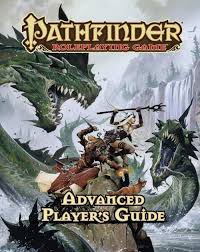
Review: Pathfinder Advanced Player's Guide

The Pathfinder Advanced Player's Guide is awesome.  Everything Paizo does seems to be awesome, and this book is no different.  Unlike 4th Edition's many extra Player's Handbooks, the Advanced Player's Guide adds to and expands the Pathfinder system, not just in adding more of the same kinds of options, but opening up all new options as well.

I want to keep these little reviews short and sweet, so I'm not going to go through everything that lies within this wondrous tome.  (Well, figuratively a tome - I got the PDF).  Rather, I would like to point out three things that are particularly good about the book, and also to discuss any flaws that I find in it.  Again, this won't be a thorough review, more like an impression.

First, the cool:

New Base Class: Alchemist
I really like that Alchemists are one of the new base classes presented by the Pathfinder Advanced Player's Guide.  They are in some ways the Paizo take on the 3.5 Artificer from the Eberron setting, but their focus is not on crafting magical items, but rather on producing alchemical items.

The most exciting application of this ability is creating grenade-like bombs which Alchemists throw in combat. They are walking with loads of potential chemical energy strapped to their backs and around their waists and in their pockets, and during combat, the Alchemist is mixing volatile chemicals on the fly and tossing them on her foes.  That's kind of cool.

Alchemists are also able to create mutagens which they can drink, Dr. Jeckyll style, to modify their abilities in a similar way to how transmutation spells like Fox's Cunning function.  As an Alchemist advances in level, she gets the chance to make Discoveries, improving her abilities, and there is even the Master Chymist Prestige Class, for those who really want to go over the top with their Jeckyll/Hyde issues.

A little note under an Alchemist's special abilities - they all receive the Throw Anything ability.  True, an Alchemist is pretty deadly armed with chemical bombs and mutagens, but I picture a fun scene with an Alchemist in a kitchen, hurling steak knives and pots of boiling water at her foes...

New Equipment
New weapons like the boar spear, sword cane, chakram and double crossbow make their debut in this book, as well as a number of new alchemical items and substances, which  makes a lot of sense with the new Alchemist class.  There is also some truly fantastic artwork depicting the various weapons and suits of armor - far more colorful and evocative than I've seen in other fantasy armories.

What really struck me, though, were the simple new pieces of adventuring gear.  Some things, like earplugs or a periscope, immediately make me wonder how I could build encounters around their use, or as a player, how I could abuse these things to gain an advantage in the game.  There are also items like the astrolabe, bear trap and compass that simply make sense, and can also be of obvious use to adventuring parties.

For those who are less than honest when they go down to the common room at the end of a hard days' dungeon-crawling, there are loaded dice and marked cards.  Overall, a lot of new cool stuff for the inevitable d20 shopping sprees at character creation and between adventurers.

New Prestige Class: Mastery Spy
It has always driven me a bit crazy that in almost all d20 systems, and in most gamist-simulationist combat-focused fantasy RPGs I've ever seen, there are heaps and piles of weaponry, racks of armor, and hundreds of combat abilities, as well as a plethora of magical spells that are aften solely useful in combat.  If I want to play a socially-focused character, a "face" so to speak, however, I'm just out of luck.  I'm going to wander, forlorn from encounter to encounter, making Diplomacy rolls and hoping that, at best, I might make some NPCs like me a little bit more.

Truly sad.

Enter the Master Spy, requiring a number of social skills at up to 7 ranks as well as the Deceitful and Iron Will Feats.  A Master Spy is going to be more socially powerful than other characters of her level, and will become a master of both disguise and deception, able to hide and even alter her alignment.  This is still a combat game, of course, so the Master Spy also periodically gets a bonus to sneak attack damage, and at higher levels, will get the assassin's death attack ability as well as the ability to entirely assume another persona at the highest level, allowing her to even fool the most powerful divination spells.

The problem remains that the Master Spy will not be as powerful or effective in combat as probably any other Prestige Class - that's just a fact of d20 in all of it's forms.  For a social-focused Rogue, however, or possibly a Bard, the Master Spy is a great choice, and I can see a game being built around an embedded Master Spy and her allies helping her from the outside, acting on the information she gathers.

Sneaky Fourth: Hero Points
Under New Rules, the Pathfinder Advanced Player's Guide introduces Hero Points.  These are very similar to my house rules of Action Points from the Eberron setting in 3.5.  Essentially, Hero Points give players more options, as well as some control over when things like character death happen.  I like this in particular because it gets rid of the 'meaningless death' issue in many fantasy RPGs - where the player fails one roll and her character plummets to her death, or is killed by the save-or-die spell, in a way that doesn't further the story whatsoever.  Screw that.

Flaws
A little artistic oversight - the swords on page 261 and 263 are being held in exactly the same way, almost like the artist was using the same sword-holding model for each painting.

Honestly, I am a serious fan of most of what Paizo does, but there aren't many flaws in this superb book.  Most of the 'flaws' I came up with were places where the book didn't go far enough, or where I wished they had included more of the great stuff they are serving up.

Conclusion

4 out of 5 vials of alchemical mutagen

Friday, November 26, 2010

Review: D&D 4th Edition Dark Sun


This is a brief take after my reading of the new campaign setting for 4th Edition Dark Sun.  I have a lot more to say, but I'm trying to be succinct.  If you have particular questions, meet me in the comment thread.

A while ago I got a copy of Dark Sun for 4th Edtion.  I've recently finished reading the complete Prism Pentad for the first time, and might talk about those in another post.  Suffice to say - the quirkly illogic of old-school D&D combined with the brutality of the setting to make an interesting read all around.  Not all of the books are equally good (the 4th one is the worst of the lot, and I might even say skip it) but I read the whole five books, which says something.

I picked up the new 4th Edition Dark Sun Campaign Setting, wondering how 4th Edition's invincible player-characters would combine with the life-is-cheap brutality of Athas.  The answer: you get a lot of 4th Edition wedded to a tiny bit of Dark Sun.

As an implementation of the Dark Sun setting, I think that the new campaign book basically fails.  There is some text about how tough Athas is, but there is very little that actually makes it tough in terms of system.  You have to spend about 5gp a day to live, and if you don't,  you start losing healing surges from lack of water and so on.  Compare this to the most physically strong character in the books, Rkard the Mul, being laid low by having to walk out in the open for three or four days, reduced to a near-dead state, and Athas really loses it's bite.

What I wanted was a grim, desperate land where travel itself, usually at best handled by a montage or a couple skill challenge, could kill you just as readily as the overwhelming collection of murderous, psionic fauna.  What you get is a way to drain 5gp a day out of your pocket.  Which, when a first level encounter might net the party hundreds of gold pieces, has little to no sting.

More than anything else, 4th Edition's take on Dark Sun convinced me that the setting needs it's own system.  D&D is not about being murdered by your harsh environment. It is not about deceit and back-stabbing and political maneuvering.  Both of these things feature prominently in the Prism Pentad books.

Where Dark Sun and 4th Edition overlap in a sweet spot is in gladiatorial combat.  I could see a game based on a cadre of gladiators in Tyr going really well - you get the monster-of-the week phenomenon without needing a lot of explanation, and you get to showcase what 4th Edition does - small-scale tactical combat with kewl powerz.

Once you leave the gladiatorial arena, though, 4th Ed falls apart as an engine for Dark Sun stories.

Rating: 2.5 out of 5 shards of obsidian.

Sunday, August 22, 2010

Review: Pathfinder Advanced Players Guide

The newest big news from Paizo is the release of the Advanced Players Guide for their Pathfinder roleplaying game, which you should buy from your FLGS. Don't have a friendly local game store? Buy it here: the best game store just about anywhere.

Since I've already told you to buy it you might guess my review is going to be positive. Like everything Paizo has been doing lately this is a high quality product. The art is awesome, the layout is superb, and the content is top notch.

A staple of D&D systems is supplements with options for players to customize their characters. Every edition of the game has had a slew of such books. The quality has generally been highly variable. Most books have one or two neat new ideas in them, and a bunch of weird crappy ideas that no one ever uses. I have shelves full of past "Complete Warriors" and "Players Handbook 14's" which have seen very little use in campaigns I've run.

This is the first such supplement I've ever purchased in which practically every page has a juicy new idea that I can immediately visualize being used in a game by one of my players in the immediate future. The feats are not retreads of things already contained in the main book. Nor are they so obtuse as to be useless for most characters. There are literally dozens of solid, intriguing feats that could be used by a wide variety of characters. The spells and equipment are similarly spot on.

But where the book really adds interest are the 6 new core classes: Alchemist, Cavalier, Inquisitor, Oracle, Summoner, and Witch. All of these classes, with perhaps the exception of the Witch, are completely original and fill niches none of the other core classes do. Upon first read I had ideas for an Alchemist, a Cavalier, and a Summoner character I would really enjoy playing. We have an Oracle in our current campaign and it fits seamlessly.

My favorite thing in the book is the Prestige Class "Master Chymist". Designed to be a route for Alchemist characters to develop it is a wonderful riff on Dr. Jekyll and Mr. Hyde. The Master Chymist functions as an alchemist preparing extracts, tossing bombs, and whipping up magical potions to boost his allies most of the time. But this alchemist has imbibed a few too many of his own mutagenic concoctions. Several times a day he mutates into his alter ego, a bestial humanoid with a different name, and personality and goals - and supernatural abilities. When you build your Master Chymist you must design the two separate personalities (required to have differing alignments) and choose the particular mutations of your alter ego, which may be animal traits or magical resistances, strength, speed, sharp teeth or claws and such.

I already plan to create the pompous and calculating Lawful Evil Dr. Finias - investigator of the bizarre and macabre, and unscrupulous purveyor of hazardous chemicals; and his uncouthe mutagenic alter-ego "Moog" - Chaotic Good party animal and super-cuddly defender of people who feed him sweets.

Tuesday, August 25, 2009

Pathfinder RPG: Skills and Feats

Skills in Pathfinder are one of the systems that undergo the least amount of change in their new edition. The big exceptions are the additions of Acrobatics, Fly, Linguistics and Perception. (4E combines Climb and Swim into Athletics, which I like)

Acrobatics
Pathfinder combines Jump and Tumble into Acrobatics, basically much as 4E does. This is just some good consolidation of similar skills. You can still tumble around, or through, opponents' squares with an Acrobatics roll, but instead of a set DC, the DC is based on your opponent's Combat Maneuver Defense - something I'll explain later when I delve into system changes.

Fly
Fly is a new skill which is interesting. It sort of makes sense, given the many ways a character might be flying in D20. Basically, you make skill checks to do things like hover or make turns when flying in tactical combat. Fly checks are modified by a creature's maneuverability score, as one would expect.

Linguistics
This is the skill that combines Decipher Script as well as speaking multiple languages. For each rank putinto this skill, your character speaks another language. This will result in characters easily speaking a LOT of languages - as I recall, this is similar to 3.0, where I think one skill rank bought you fluency in a language.

Perception
Perception is just a combination of Listen, Search and Spot, which is a good way to simplify (which 4E also uses).

Next, we turn to Feats.

When I read the Feats section of the Pathfinder RPG, I was surprised at how many there were. There are four full pages of Feats listed in a table much like you found in 3.5 (though it was half as long). Some are genuinely new, whereas others are taken from supplements. A large number of Feats are expansions of combat Feats you're probably already familiar with. First I'll mention a few Feats that are expanded upon (that is, longer chains attached to them), and then I'll pick out a couple interesting individual Feats.

Combat Expertise has 7 Feats it is a prerequisite for, where Critical Focus (distinct from Improved Critical) has 9 in its chain. Dodge has Wind Stance and Lightening Stance as well Mobility and Spring Attack; Improved Unarmed Strike has a total of 8 Feats attached to it. There are also more missile feats, more rooted in Power Attack, and Weapon Focus has 9 in it's 'chain'. (This is good news, considering characters will have a lot more Feats than in 3.5, getting one at every odd-numbered level - giving Fighters a Feat per level, for example).

Arcane Armor Training
There are two Arcane Armor Training Feats, and each reduces your Arcane spell failure chance due to wearing armor. I've always liked this idea, not necessarily buying that arcane spellcasters have any logical reason to be "clothies" other than long-standing convention.

Deadly Aim
This Feat is like Power Attack, but for ranged attacks, which is a cool idea.

Intimidating Prowess
This Feat is a house rule of mine - you add Str to Intimidate checks rather than Cha. This has always made sense to me, since being huge is in itself intimidating, regardless of what your social skills look like.

Vital Strike
This Feat is kind of exciting if you want to just deal out damage. This Feat lets you double your weapon damage dice on a single attack...every time. If you have multiple attacks, then the one at your highest attack bonus doubles it's dice. So that longsword now deals 2d8 if you hit with your best attack, and so on. And yes, you can build on the Feat from there, dealing 3x and even 4x dice in damage with your highest attack.

There are a lot of other exciting Feats in the Pathfinder RPG, but I don't want to go into all of them. Suffice to say, you'll still have hard decisions to make when choosing Feats as you level, and looking through, there are enough Feats to take away the 'obvious' Feat decisions from 3.5's core PHB. This means more versatility and more interesting specialization. I can see multiple Fighter builds, for example, that would be very different from each other, and that in itself is cool.

Sunday, August 23, 2009

Pathfinder RPG: Races and Classes

Let's get right down to business, shall we?

In Pathfinder, attributes are no different from 3.x, but races have been beefed up. Pathfinder, in general, makes characters stronger at level 1 - something Paizo and WotC agree on, apparently.

Dwarves
Dwarves have all the usual weird AC and attack bonuses against giants and goblinoids and so on, as well as their usual Stability ability. The main difference compared to 3.x is that Dwarves get a +2 to Constitution and Wisdom to go with their -2 to Charisma. Their fluff is what it always is - gruff blah blah blah honorable blah blah blah stone and metal, etc.

Elves
D&D's metrosexuals get +2 to both Dexterity and Intelligence to balance their -2 to Constitution. Otherwise, they are generally unchanged in fluff and so on.

Gnomes
Based on their artwork in the book, Gnomes seem to be the sort of zany trickster' race (whereas Halflings tend to be creepy and childlike). Gnomes get a +2 to Constitution and Charisma and the usual -2 to Strength. One additional ability is Obsessive, which gives them a +2 to a Craft and a Profession of their choice. Their fluff is what you'd expect.

Half-Elves
The other metrosexual race gets a straight +2 to an ability of their choice. They also receive the Skill Focus Feat for free at 1st level. Lastly, Half-Elves choose 2 favored classes, and they get the +1 HP per level or +1 skill rank per level bonus when they take levels in those two classes (and that's how favored classes function - you get one of those two bonuses).

Half-Orcs
Oddly, Half-Orces also get a +2 to an ability of their choice - even though all of their fluff implies a lack of Charisma and their art implies a whole lot of Strength and Constitution. Otherwise, they are Intimidating (they get +2 to Intimidate), and they have Orc Ferocity, which lets them fight on at exactly 0 hit points for one round before they are knocked unconscious.

All in all, I think that Half-Orcs get the short end of the stick...as usual.

Halflings
The wee ones are still wee - not the enlarged 4E versions. They get a +2 to Dexterity and a +2 to Charisma and the usual -2 to Strength. They also get the bonuses they did in 3.5, so nothing big that's new here. Halfling fluff has them as scavengers at the fringes of society when they settle down, or nomadic wanderers otherwise.

Humans
Like both half-races, Humans get a +2 in any ability, and their usual extra Feat and Skill rank.

Now, to the classes...

In listening to a lot of interviews with the Paizo guys and reading what they're writing about their work, they had a goal for each class that every level would give you something more than the basic extra HD and so on. Everyone gets candy at every level. You also get a Feat every two levels - but in addition to the Feat, there is still candy.

Oh, good to note - as we get into caster descriptions, all casters (Bards, Clerics, Druids, Sorcerers and Wizards) have 0-level spells that they can cast all day long. This is cool, but I don't want to repeat it :)

Barbarian
The candy that the Barbarian gets is the ability to add effects to her Rage ability, like Animal Fury or Guarded Stance or No Escape (what are these? Buy the book! :). These powers just stack up, so at some point when you Rage, you become a crazy killing-machine. Otherwise, the Barbarian is very recognizeable from 3.5.

Bard
Bardic Knowledge is expanded a bit to make it more versatile, and the end result is that the Bard is the master of Knowledge skills, whether she has ranks in them or not. Bardic Music is also expanded in power and versatility, and the Bard retains her spells. The Bard is one of the classes to get a bump in hit dice, so each level you roll a d8 instead of a d6. As they level, Bards also become masters of using skills untrained, and at level 20, a Bard can kill with her musical performance. Nice.

Cleric
The biggest thing about the Cleric, for me, is the loss of Turn Undead (though it rears its ugly head as a Feat...). Instead, you just channel positive or negative enrgy - if you read the playtest pdf, then you're already familiar with this, as well as the fact that Clerics can use medium armor but not heavy. Another cool change is with Domains - not only do you get the bonus Domain spells, you also get one of two Domain abilities for each of your Domains - and these are cool, colorful, and useful.

Druid
Clerics have Nature's Bond, which gives one option as having an animal companion. The other option is to have a Cleric Domain: Air, Animal, Earth, Fire, Plant, Water or Weather, including the bonus spell and powers associated with it. Otherwise, actually, Druids haven't changed much from 3.5.

Fighter
Fighters get an overhaul and a straight infusion of awesome. They still have bonus Feats as in 3.5, but they also get a Bravery bonus to Will saves against Fear (something I've always wanted). They also get Armor Training, which reduces the penalties for heavy armor, as well as Weapon Training, which gives stacking +1 bonuses to categories of weapons so that at 20th level, a Fighter can use one category of weapon and get a +4 to hit and damage, as well as confirming every critical hit automatically.

Monk
Monks are also very much the same, except they have a ki pool, a pool of points that the Monk can spend to make extra attacks, go faster for a round or dodge for effectively.

Paladin
The main difference with Paladins is that their Lay on Hands gets augmented significantly. Now, when a Paladin uses her Lay on Hands, she also has an ability called a Mercy that takes effect. What the Mercy does is it removes one or more conditions from the recipient of the LoH. A Paladin also has overlapping Auras, each granting her immunity to some kind of supernatural effect and granting her nearby allies a bonus to defend against it.

Ranger
The Ranger gets bumped back up to d10 hit dice, and on top of the Favored Enemes, the Ranger also gets Favored Terrains. The Ranger also has a new Quarry ability, which is a lot like marking abilities from 4E or MMORPGs, meaning the Ranger chooses one target and murders it.

Rogue
Rogues have talents now that at every even level, alternating with Sneak Attack. Talents include crippling and bleed effects, as well as defensive abilities, some culled from 3.5 supplements and some originals like Dispelling Attack.

Sorcerers
Sorcerer bloodlines are expanded upon, and add a lot of coolness to the class. The Sorcerer is assumed to have her abilities because of her ancestry - she has some kind of supernatural blood flowing through her veins, including undead, demonic, draconic or fey. This bloodline gives her specific bonus spells and a few abilities as she goes up in level which are in line with the bloodline.

Wizard
Wizards now get special abilities when they specialize in a particular school, including some kind of at-will basic attack ability which is a nice bonus for the Wizard, particularly at lower levels when you blow those couple Magic Missiles and then twiddle your thumbs in previous editions.

Basically, every class is improved and made more interesting, as well as more powerful. I can only assume the RPG Bestiary will make all these new powers necessary. Pitting these new classes against 'classic' MM critters just seems unfair...

Next up, Skills and Feats

Monday, August 17, 2009

Pathfinder RPG: First Impressions

At 575 pages, this book is a heavyweight in the RPG world. Not quite Ptolus heavy, but a runner-up, up there with Hero, and potentially just as able to stop a bullet.

From the get-go, it's worth noting that Paizo's Pathfinder RPG is D&D 3.5 with some changes. If you didn't like 3.x, you won't like Pathfinder. If you liked 3.x, then Pathfinder is better in pretty much every way.

Layout and design for the book is pleasing but also simple. There's probably art on every 3rd-4th page, and it is the beautiful, evocative artwork that I associate with Pathfinder.

The chapters are as follows:
Getting Started
Races
Classes
Skills
Feats
Equipment
Additional Rules
Combat
Magic
Spells
Prestige Classes
Gamemastering
Environment
Creating NPCs
Magic Items
Followed by Appendices 1-4

As you can see, this book covers the territory of the original PHb and DMG together, making the price-tag ($50) actually pretty reasonable.

Next, I'll be delving into this heavy tome, focusing on races and classes, then feats and skills, followed by combat and prestige classes, then magic and magic items, and finally some closing thoughts. So an Pathfinder-stravaganza. Before you bother to read all of that, though, I want to reiterate - if you like 3.x D&D, get this game. You will like this better, and I have a feeling that Paizo will stick with this for a long time yet before they try any Pathfinder 2.0 crap :)

Saturday, June 20, 2009

Mouse Guard Rules!

I just finished running a session of Mouse Guard for Free RPG day at my Friendly Local Game Store, and it was one of the most fun times I've ever had running a game. Mouse Guard is clearly the culmination of all of that work Luke Crane put into Burning Wheel and Burning Empires, and it surpasses both in every way in my opinion (well, not in complexity, but in every other way).

The Scenario and Actual Play Impressions
The scenario was pretty simple. The players polished off their Guards by writing Beliefs, Goals and Instincts, and filling in a single Wise that I gave each of them but left blank. (One chose Weasel-wise which was hugely helpful later). It was winter, and the four Guards were called out of R&R to find out what happened to a pair of Guards who were sent west from Sprucetuck with important messages some time ago. They never returned, and the worst is assumed.

After getting into a scrape with an owl and learning some details, they arrive at a small new settlement near the eaves of the Darkheather. There they get into a social conflict with the head mouse of the settlement, who wants them to stay with them all winter and protect them from weasels. The Guard, however, knows that a terrible winter storm has been predicted by the sciencemice of Sprucetuck, and they have to convince the settlers to return east with them and winter in Sprucetuck - or they'll likely freeze to death.

The PCs win, but with a big compromise - the settlers want proof that the local weasels are dead before they'll move. The PC Guardmice set up an ambush for the weasels and completely own them. By Action 2, the weasels are dead. Nice job!

The last conflict is between the Guardmice, who are leading the settlers through the snow, and the onrush of the first part of the predicted winter storm. So I, the GM, get to play as winter and try to freeze them all to death. That was a lot of fun.

One of the most fun parts of the game, for me, was when the players would shoo me away from the table so they could strategize and then call me back when they were ready. I really love player empowerment.

As winter, I win with a major compromise, so I killed one Guard and a third of the settlers, but the rest arrived in Sprucetuck Hungry and Thirsty and Sick.

Every one of us had a great time for almost 100% of the session, which with RPGs is largely unheard-of. Well done, Luke. Well done.

From the GM's Point of View
This five-hour scenario for four new players took me all of three or four hours to prepare last night - usually the best ratio I get is one-to-one for games that require prep, and if you were willing to leaf through the book more and were more familiar with the rules, I bet you could do with a lot less. This is my first time running, remember.

Comparing it to my first time running Burning Wheel, this was 1000x easier to learn, prepare for, and teach to new players. I didn't have to change anything about the game to run it the first time. We took about the 30 minutes I predicted to explain the character sheets, basic rules and conflict sheets, and then we dove right in.

I had a lot of fun in the argument conflict playing the leader of these settlers trying to wheedle and coerce the Guard into staying to protect them, and I had a lot of fun playing winter and figuring out what a "Maneuver" action was when you are playing a season. But I loved the image of winter as a character in the story actively trying to kill the mice - that is very dramatic, and made me think of the blizzard on Caradhras in the Fellowship of the Ring. I've never seen a system that replicates that kind of experience, and it is probably the thing I am most greenly jealous of as a game designer. Again, well done.

"4th Edition Burning Wheel" Wins
I give this game a 5 out of 5 in every category I can think of. It is hands-down one of the best systems I have ever played. My only consolation is that it took Luke Crane four tries to get to this point with the Burning Wheel system.

It is cold comfort...but a hot, hot, hot game.

Saturday, February 14, 2009

Mouse Guard, AKA Burning Wheel Fourth Edition

I had a whole post planned out to talk about Burning Wheel - how I think it is a wonderful, well-designed game, but why I think it is not an elegant game. But then I picked up a copy of Mouse Guard - which I'm thinking of as Burning Wheel Fourth Edition. (First Edition would be Burning Wheel "Classic", Second Edition is Burning Wheel Revised, Third Edition is Burning Empires, and Fourth Edition is Mouse Guard)

Mouse Guard is an elegant game. It is the direct descendent of both Burning Wheel and Burning Empires, and it is better than either one. It is better written, better presented, better designed. It is clear that Luke Crane continues to learn as he goes, with each game better than the next. (This fact makes me more excited about Free Market)

I've seen other gamers pick up Burning Wheel, and then sort of get bogged down and paralyzed because it is such a complicated game. The problem is that Burning Wheel Revised is about a dozen systems under one roof. They work together, but they're like an internal-combustion engine in that way - you raise the hood and its a bewhildering amalgam of movement and noise, and it takes some training to become familiar with all that is going on. I read the base books twice each, and ran the game twice for different groups, and each time, I realize something I ran a bit wrong, or missed entirely, or misinterpreted.

Burning Empires builds complexity onto Burning Wheel rather than removing it, but introduces defined turns and more information on how and when to frame scenes. Those two things are brought into Mouse Guard, but they are slimmed down and simplified.

Reading Mouse Guard, I felt a sense of elation. Its like I got to sit down with Luke Crane and tell him what I thought he should change about Burning Wheel. Most of what I would have told him made it in. All conflicts now look like the Duel of Wits. Conflict Scripting is more versatile and standardized, with only four maneuver types to choose from. The test-tracking system for advancement is much simpler and more logical by far (hint: no huge chart necessary to figure out what's going on). The attributes are simplified, and learning new skills is as well. There are no massive lists of interconnected lifepaths to navigate in character creation. There's no confusing wheel to track wounds, no special weapon system to make the brain hurt. I could go on, but you get the picture.

I say all of these things as a person who loves Burning Wheel, who has a lot of fun running and playing it. But Mouse Guard is better in every way. It is clear, concise, well-written...elegant. It is one of the best games I have ever read, and I look forward to playing it.

Sunday, November 2, 2008

Hunter: the Vigil and the New World of Darkness

The New World of Darkness games seem to be intentionally designed to give players insane results. In the old world of darkness system, you could get crazy results, but it was because you gamed the system well - you set up a roll with lots of dice and low difficulty.

In the NWoD, everything is target 8, so successes can be relatively rare, but you also have "exploding dice", re-rolling 10's and sometimes even 9's and more rarely, 8's as well. This means that the most common results of rolls are one or two successes or a large number, and it comes out of nowhere. It is also less under your control. Even when you can make some of your successes explode, they are relatively rare, so its more of a game of luck and randomness.

One effect of this that I found in my own play is that it turns the game towards comedy. There is a lot of botching and absurd successes, and it is hard to handle.

The exception here is in combat, when some kind of defense number is subtracted from almost all of the dice-pools for attacks and special abilities. This means that you're rolling fewer dice than you're used to, which in turn means that combat involves a lot of singular successes or marginal failures.

This can get to be...a little unexciting. Your vampire grows her agg-dealing supernatural claws, leaps from the rooftop onto her opponent, slashes the claws down his back, and deals...one aggravated damage. Nowhere near a would penalty or anything. A scratch, really. Then in rage he turns around, pulls out his Desert Eagle, shoots you, and deals...two bashing. And so it goes until one of you has some exploding dice and randomly ends the battle in a paroxism of bloodshed.

I like a lot of the changes that were made to Vampire, Werewolf and Hunter. I think that Mage took a step backward both in its fluff and in the system itself in almost every way. But the dice system is just sort of hard to manage sometimes. It doesn't work for me. It doesn't deliver the play experience I want - it isn't reliable when it should be, and it isn't exciting when you want it to be.

I find that I'm left wanting to hack White Wolf's games all the time. When we used to run V3 (Vampire third edition), we probably had a minimum of house rules, but by the end of a chronicle we had a few to make the system more playable.

I wonder - did they playtest the new system before they brought it out? It just comes off as...unfinished in a lot of ways. So you have huge, beautiful books with unfinished systems in them that don't deliver what you want them to deliver.

I sort of want White Wolf's graphic designers and artists and setting designers to team up with Paizo, maybe, or a team of designers who can create a game that is tight, efficient, and delivers when you want it to deliver.

We just had a session of Hunter: the Vigil with some members of our new home group we're trying to put together, and it went really well and was a lot of fun. It isn't like I'm not having fun with White Wolf's games - I almost always do. It just isn't...reliable. Their new system, its core dice mechanic, just isn't as good as their old one, and it takes something away from the game that used to be there. I'd have kept a similar dice system, with variable pools and variable difficulties on d10s, because that just lead to a more interesting game, a system that the players can use to set their characters up for huge success or for big risks at critical moments. The dice helped the game along - not so much with the new WoD stuff. Its really too bad.

Sunday, October 5, 2008

Desolation RPG and the Ubiquity System

I just paged through a copy of Desolation, a post-apocalyptic fantasy roleplaying by Greymalkin Designs, which liscences the Ubiquity system. The reason I mention this is that I'm not sure why they liscenced it (from Exile Games) at all.

The Ubiquity system is a lot like a dozen other systems where you have the same attributes as D&D (Body, Strength, Dexterity, Intelligence, Wisdom and Charisma in this case - so, ok, they changed the name of Constitution to Body, but you get the idea). It also has "Talents", which are Feats with the name filed off, and skills that are rooted in the attributes which are eerily familiar.

The dice system itself isn't meaningfully a dice system at all - all of the dice are basically the same as coins you flip. Evens are successes and odds are failures. That's it. You add up the successes. What I mean is, it doesn't matter that you're using dice - so why use them?

Oddly, it is even possible to get your hands on special Ubiquity dice, which...just seems extra odd to me. Why?

I think that the Ubiquity system comes with one really cool setting - Hollow Earth Expedition. People have run HEX at the store before, and players have had a really good time shooting dinosaurs and Nazis from biplanes. That's good times however you slice it.

It just seems really odd to me to license a dice system that is basically a coin-flip system - even Burning Wheel, which is also basically a coin-flip system, has shades, so that some dice-rolls aren't just straight 50/50.

I really don't see a reason to create the Ubiquity system at all. I think it would be easy to adapt another system, even one that would be free to license, for the settings that they're putting out. It doesn't have elements that aren't already in a dozen other games. I understand the desire to have a new system for your new company putting out new books and all that, I just think it could've been done more easily. There's nothing about Desolation or HEX that requires a new system, and if I was going to design a system for either, I'd try to have a dice mechanic that somehow added to the experience, rather than just having various ways to flip coins...

Other than the dice and system, Desolation's post-apocalyptic setting has most of the fantasy tropes you'd expect - the races you see everywhere else (some under different names) with the common generalizations which hold true for them as well.

What will be really interesting is to compare Desolation to the 4th Edition D&D incarnation of Earthdawn, which I believe is coming out next year. Earthdawn is sort of the original post-apocalyptic fantasy setting, the most recent incarnation of which is over 10 years old. Its doubtless going to get updated, and really fits the "points of light" theme of 4th Edition. I'll be curious to see how WotC adapts the setting and how it compares to Desolation, given that in the generalities they are going to be very similar (and overall I must admit a preference for Earthdawn, which years ago was already dropping some of the entrenched D&D tropes...)

Friday, August 22, 2008

Ashcan Review Part 1: How We Came to Live Here

I've been reading through Brennan Taylor's ashcan of How We Came to Live Here, which he has posted for download. This is fortunate, because this year conventions aren't happening, so I unfortunately won't be able to get any of these ashcans in person.

I have long been of the opinion, particularly after doing my undergraduate work in religious studies, that the vast majority of rpg magic systems are horrendously awful. Magic is basically nothing more than someone else's religion. So often, magic systems are put out there which are entirely devoid of color and particularity, or their color and particularity are completely arbitrary and uninteresting.

I thought of this persona rant while reading How We Came to Live Here because it is so incredibly strong in this area for a lot of reasons, the most important of which might be that the magic system he presents is not a magic system at all - it is a life system. Unbelieveable! That what amounts to "magic" would just be people's beliefs about how the world works and how they interact with that world and with each other! This is one of the only instances in fantasy in general, and in rpgs in particular, when the magic system has been anywhere near as interesting as the religions and occult practices here on planet Earth. ::Applause:: Like a good anthropologist, Taylor gives us an inside view of this culture which is different from, well, my culture at least, as well as his - an inside view which is affirmative. These things are true because they are true for the People. What you're sort of swept into is this holistic system of life that is presented, where supernatural and mundane things are all caught up in the same over-arching system.

In effect, I think, a good "magic system" is one where there is not any "magic" at all, if by "magic" you mean something separate from the life of a particular people at a particular time. It always bothers me when Elves and Orcs approach magic like Enlightenment philosophers, relegating everything to its hermetically-sealed category, casting spells that have no real meaning in their lives, which aren't based in anything important, which are essentially flashy-but-arbitrary shortcuts.

In contrast, the strength of HWCtLH in this regard comes from Brenna's stated goal of representing, faithfully, a fantasy setting that is based on a culture that is not his own - that of the southwest American natives whom he lived near growing up and whose beliefs and practices he also studied in college. He describes his game as a king of fantasy setting for the Anasazi people rather than for northern Europeans. I think it is this change in viewpoint that enables him to make this excellent presentation of a "magic system" that is actually interesting and evocative, even compelling.

I will try to put together a playtest of this game. Right now, I'm jealously trying to finish Parsec so that I can move on with the lessons I've learned from my first foray into rpg publishing, and I'm also running a Spirit of Eberron game, but hopefully I can put something together so that I can give him some more concrete feedback on this game.

I can't speak about the mechanics of the game so far - they seem like they'll work on paper, but I'll have to put that playtest together to actually figure them out. But I'm loving reading this book for its own sake, which hasn't happened in a long time for me when it comes to rpg books. You can really tell that this is a labor of love, something that Taylor feels passionate about. It shows through even in his relatively simple, straightforward text. I look forward to test-driving it.

This was Part 1 - Part 2 will come when, and if, I get to run the game. Even if I don't, I'll probably have more to say about how I think it'll work when dice hit table...

Monday, June 23, 2008

A One-Shot of Ice and Fire

I have mixed feelings about licensed material forming the basis of an RPG. In some cases, where the universe of the base material is sufficiently expansive (such as Star Wars) it can work. But if the source material is too closely wedded to certain characters (as with Serenity/Firefly) then I am less inclined to enjoy it. The appeal of the original world is simply too closely tied to the personality of the original characters and every game using the setting is going to feel derivative.

That makes Green Ronin's latest venture into the world of Westeros from George R.R. Martin's series of novels a tricky proposition. Part of Martin's genius is his gift for creating rich memorable characters. On the other hand, Westeros is incredibly detailed and there is such a dedicated fan following that it is hard to fault anyone for making the attempt. There have already been several forays into game design for Martin. There was a previous RPG using the D20 rules. There is a strategy board game, and a card game as well. So Green Ronin has their work cut out for them to distinguish themselves and make a game which will have an impact on this crowded market.

This past Saturday was Free RPG Day and Green Ronin released a preview set of their rules for the game and a test module to be run on the day. I was sufficiently intrigued to run it at Gamescape North in San Rafael and I am extremely pleased to say that this game delivers on everything it promises. I have not been so excited about a new RPG release in quite a while. Song of Ice and Fire Roleplaying (SIFRP) is a gritty, elegant, profound game that hits the nail on the head in terms of mood, mechanics, and material. 

If you are familiar with the books you'll know what a mismatch the D20 ruleset was for this material. D20 is all about combat simulation and heroic adventuring whereas Westeros is a place of intrigue, politics and gritty realism. No one should ever take a sword blow and shrug it off as a mere 1d8 hit points damage. Players should fear the very real danger that live steel presents and prefer to solve problems with their wits and careful planning. This game needed a a ruleset that would deliver on a crunchy in-depth intrigue system and Green Ronin has done just that.

Intrigue deserves a post of its own, but I will summarize here. Every character has ratings for Intrigue Defense, Status, Persuasion, Deception, and Composure. Aspects like Disposition and Frustration come into play, also, and you will be choosing to use techniques like Bargaining, Charm, Seduction, Taunting and so on... As an Intrigue progresses in exchanges parties will gradually lose their composure until one person gets the better of the other and gets what they want, which could include information, could be a new friend or ally, or it could be to cause their opponent to lose their cool and do something rash. The possibilities are endless. The system is slick. It is fast to learn and run and it provokes players to be better roleplayers - which is the highest compliment I could possibly pay to it.

Green Ronin also succeed on the fluff. They've obviously paid close attention to Martin's world and done their best to evoke it in mood and flavor without just using canon material. The module they sent had great characters with depth and complexity to them, portraying all the roles the books suggest - a Maester, a Septa, a Bastard, a Knight, a Lord, a Squire... Their descriptions of places and suggestions for NPC's were on target as well. I do have one criticism of their module design which is that it was way too vanilla to be an adequate introduction. I understand the philosophy that you want to have an introduction be simple since players will all be learning the rules, but I think it is shooting yourself in the foot. You want your first impression to be as good as possible and so they should have put together a module that was far more detailed and highlighted the things about the system that are unique - particularly intrigue. Instead they threw us a story about bandits which could have been in any D20 game.

So, of course, I modified the module heavily. Instead of being mere bandits, they were men hired by a family still loyal to the Targaryens to waylay and kill a Knight on the way to the tournament. There were family feuds and hints of a plot to bring a poisoned blade to the upcoming tournament at King's Landing - perhaps to kill King Robert in the Melee! I made 9/10 of the game about these intrigues and threw in a little combat with the bandits just to spice it up. Green Ronin could certainly have done more with the module to impress folks, but I'm just happy with how  easy it was to concoct all of this intrigue on the basis of the system they've made.

This game gets 5 out of 5 stars from me for sheer originality and grace. It is totally different in feel from any medieval fantasy game out there right now and I hope it sells like gangbusters.

Wednesday, June 11, 2008

4th Edition D&D - Reivews - Kobolds

Like Goblins, Kobolds have been reworked in the 4th Edition Monster Manual, and I really like the change.

Kobolds

Like Goblins, Kobolds can also shift 1 square with a minor action at will. Kobold Skirmishers and Kobold Dragonshields have an extra ability called Mob Attack. What Mob Attack means is that these Kobolds get a +1 to all attacks for every Kobold that is adjacent to the target they are attacking. You can easily see how this will be bad news for a race that loves to set traps and then swarm all over you in large numbers.

But there's more. There is the Kobold Slinger who has his special shot. He can hit you with a Stinkpot, which deals damage and and imposes a -2 penalty to attack rolls until you make your save. He can also hit you with a Firepot, which deals damage and then deals a little bit of ongoing fire damage until you make a save. Lastly, there is the Gluepot, which immobilizes you.

So here's how this goes. First, at range, a bunch of slingers sling you, so that you are potentially at -2, on fire, or immobilized. Preferably, all three. Then, you are swarmed by Kobolds who are getting bonuses for every other Kobold near you. This swarming means that your Wizard or other Controller will have a lot of trouble clearing out Minions with blasts of arcane energy.

While being swarmed, you are still being attacked by the Slingers, who continue to shift to better positions and rain down stink, fire and glue for the duration of the battle.

You'd better hope there is no Kobold Wyrmpriest with them, because as an encounter power which is a minor action, he can Incite Faith, granting all Kobold allies within a close burst of 10 5 temporary hit points and letting them all shift one square as an immediate action.

Covered in poo, on fire, glued to the floor, and swarmed by shifty Kobolds who get stronger the more of them there are fighting you. Sounds like quite the way to die.

Tuesday, June 10, 2008

4th Edition D&D - Reviews - Goblins

These reviews are just going in whatever order interests me. If there's something else anyone wants to talk about, lemme know in the comments.

Goblins and Kobolds are two of the quintessential races for low-level PCs to pound on in D&D. Both races have been reworked in the 4th Edition Monster Manual, which I think is the best of the three core books by a significant margin.

Goblins

The entry for Goblins includes Bugbears and Hobgoblins. Bugbears have kind of a brutish, thug appeal. The Bugbear Warrior has the Skullthumper encounter ability which enables him to knock you flat and daze you until you can make a save. The Bugbear Strangler has the Strangle at-will ability that is basically a high-bonus grab followed by an ongoing 1d10+4 damage until the target overcomes its -4 penalty and breaks the hold. Bad news, and fun twists on the biggest Goblinoid.

The Hobgoblin has the usual soldier feel, with phalanx-fighting and formation-fighting abilities to use when fighting in military units. They also have Hobgoblin Resilience, which allows them to roll an immediate save against an effect that allows saves once per encounter.

The Goblins, however, have the scariest combination in my opinion. All Goblins have Goblin Tactics, which is an at-will immediate reaction to being missed by a melee attack. When missed, they can shift 1 square. Big deal, right? But incomes the Goblin Hexer, who has Incite Bravery. This allows the Hexer, as an immediate reaction, at will, to shift a Goblin ally another 2 squares whenever it uses Goblin Tactics. The shift is followed by an immediate attack.

So if there is a Goblin Hexer in your combat, every time you miss one of the Goblins within 10 squares of him, that Goblin can immediately shift 3 squares and make an attack. Goblin ACs are between 15 and about 17, so that means at 1st or 2nd or even maybe 3rd level, you'll miss a given Goblin 1/2 the time. So half of the Goblins you're facing get to shift an extra 3 squares and attack you.

That sounds like a lot of fun - for the Goblins.

Oh, did I mention that the Hexer can also Blind you with an at-will power that also deals damage? Because he can do that too.

Coming next - Kobolds!

4th Edition D&D - Reviews - Alignment

Alignment is one of those things that I've thought of as broken for a long time. I've talked about it before, though the thinking didn't really go anywhere at the time. The best use of it alignment, to me at least, was in the original Dragonlance setting (and it still left something to be desired). That is one setting that left a mark on me in my formative gaming years during early adolescence, and it made alignment overt through two basic means - the Towers of High Sorcery and the Holy Orders of the Stars.

In the original AD&D campaign guide for Dragonlance, the one with Tanis on the cover having just killed the Dragon Highlord and taken his crown, there was actually a sort of chart that the DM was to use to track alignment changes. At the left-hand side was Good and on the right-hand side was Evil, with Neutral in the middle. Between each range was a grey "Transition" area. Each major act a PC committed would either keep them where they are or move them in one direction or another. When in the Transition area, the DM was supposed to give hints that they were slipping - toward a fall, or perhaps redemption.

The reason this mattered was that for Wizards and Clerics, alignment was key. Wizards had three orders, one committed to Good, one to Neutral, and one to Evil. The gods of Krynn were the same way - Good, Neutral and Evil sub-pantheons. The Krynn setting was all about balance, and Neutral usually functioned to throw its lot in with either of the moral poles when the other one became too powerful to be balanced.

Anyway, to make a long story short, that's as good as I've seen for alignment. Aside from that, players don't take it very seriously, except for the occasional jerk who wants to sandbag your game by playing Chaotic Neutral all the time, or the other kind of jerk who frustrates everyone by playing a Lawful Schmuck Paladin. (It doesn't have to be bad, but it usually is)

In 4th Edition D&D, the alignment system has been pared down to five options - Lawful Good, Good, Unaligned, Evil and Chaotic Evil. Not having their rationale in front of me, my first reaction to this is that it is, how do you say, "stupid". They have turned a weak-but-traditional alignment system into a weaker one that is a break from D&D's past. In fact, it seems to frankly be double-stupid.

No freedom-loving Chaotic Good heroes? No tyrannical Lawful Evil villains? No disciplined Lawful Neutral monks? No Chaotic Neutral lunatics played by obnoxious players? It seems like they have taken a weak system and hamstrung it.

They could have gone with what they have instituted with the Minis game, where there are Good, Unaligned and Evil alignments for each card, and you can't mix Good and Evil in the same army. That's simple, basic, and it makes some kind of sense, and it serves as a counter-point to the faction system they're using, of Civilization, Borderlands, Wild and Underdark.

From their description of the reasons for the change, I get the impression that Good has swallowed up Chaotic Good and Evil has swallowed up Lawful Evil. This just doesn't make sense, however. I like alignment better, if there must be a spectrum, as a double-spectrum of Good-Evil and Law-Chaos. It just has more potential to be descriptive and interesting.

The only good thing about the change is Unaligned. I like that idea, though in play so far, the players of Unaligned characters are basically treating it like Chaotic Neutral used to be - the quintessential alignment for doing random things and pretending that they make sense because they're 'in character'. In theory, however, I like the option of just being someone who doesn't have strong moral commitments either way - unlike True Neutral, which is often depicted as a commitment to balance of some kind.

My proposal:

I think that with this change, I'll feel more inclined to jettison the 'official' take on alignment entirely, and replace it with something else. What I'm thinking of is to have your "alignment" be the thing which is most important to you. Then, once you've said what that most-important thing is, I want to use an indie-game trick and reward you for putting that thing in jeopardy or putting it at risk in some way. That could be the way to earn a little bonus XP maybe, or perhaps the way to earn Action Points (which I've long used as a reward rather than a boring rechargeable point-pool). It is also a good way to find out, in a single word, how you might get the player's and character's attention in the game early on. You know where to start pushing at least, and that's an improvement on the system 4th Edition presents us with.

Saturday, June 7, 2008

4th Edition D&D - Reviews - Tell Me What You Think

4th Edition D&D - Reviews - First Impressions

I should be sleeping, but instead I thought I'd start sketching out my first impressions of the new 4th Edition books. Like many others, I got mine as early as possible, and have seen certain PDFs that might allegedly exist which may or may not have leaked about a week before the official release.

This first bit will be pretty brief, and I'll get into more detail in later posts.


First, the Player's Handbook

The art and production values, layout and so on are top notch in my opinion. I've found very few typos and misspellings or syntax errors as I read through the text, and in general I think it is an upgrade from the previous editions physically and in terms of layout and overall design.

That being said, I can't say I'm happy with the direction they've taken things. I've already expressed my disdain for healing surges, and that feeling remains. They're unnecessary and don't appear to increase fun or verisimilitude, meaning they are useless and should be cut. The only concern I have is that encounters which WotC publishes for 4E will assume you have them, so they'll probably be a little tougher than they would be without the surges. Again, we'll see about that.

The WoW ripoffs continue with disenchanting magic items. I knew about this before-hand, but it was still disappointing to read about it. I shouldn't be surprised I suppose. 4th Edition is very clearly Tabletop WoW.

The Warlord is a crap class. You can quote me on that, and I'll stand by it. I suspected as much when it was described by WotC, and in reading through it, I am re-affirmed in my suspicion. Clerics do what the Warlord does, and they do it better and for better reasons.

I can't think of any reason to drop the Bard and add the Warlord. The Bard could easily fill the role of Arcane Leader and could do the Leader job in a far more interesting way than the Warlord does.

As it stands now, the Cleric, Fighter, Warlord, Paladin, melee Ranger and melee Rogue will all be literally jostling each other, shoulder-to-shoulder trying to squeeze in melee attacks against their foes so that they can use their abilities. For a game that's supposed to be tactical, I see a lot of clumping in the future, since there is no such thing as a Cleric who can stand back and cast or a Warlord who can lead from anywhere but the front of melee combat.

Also, a side note on saving throws - WTF? You just roll 10 or better on a d20? That's it? More powerful effects aren't harder to resist? And it breaks the established system of [1d20 + 1/2 level + ability modifier + other modifiers] that everything else functions on? Why the hell would you do that? Its just stupid.


Next, the Dungeon Master's Guide

I haven't gone through it as thoroughly as the PhB, but overall I think the DMG is a big imporvement on its predecessors. It offers a clearer method for creating encounters which are skill challenges or puzzles or traps and more directly ties experience points to these kinds of non-combat encounters.

There are much better rules for things like negotiation or interrogation - far more interesting than rolling Diplomacy and consulting the NPC Attitute Chart. You might actually have viable, interesting social conflicts which the rules let you do something with. Everyone I know had house rules for 3.5 to handle this, but its nice to have these rules in the book as well.


Finally, the Monster Manual

This book is the best of the three. Smaller stat-blocks give you all the info you need to run an ancient dragon in combat in 1/4 of a page of text. There are also a lot of new, interesting tactical options for basic fodder like Goblins and Kobolds. I can't wait to combine Goblin Hexers with Goblin Cutters, or to have PCs brought low by Kobold-swarms as sling-thrown bombs rain down on them.

The art is notched up once more. Some of it is recycled, like the Vampire art, and some of the redesigns, like the Troglodite, are steps backward, but a lot of the changes are good. I'm not sure why they changed the head structure of the Green Dragon but not of the other kinds of chromatic dragons, but I do like the new Troll look - a little more Tolkienian and hulking rather than lanky.


Overall First Impression

In an act of grand irony, I give D&D 4th Edition 3.5 out of 5 stars. Improvements in the DMG and MM don't out-weight the problems I see with the basic class and ability design in the PhB - and the PhB is the thing you reference most. I've also moved bit by bit farther away from a D&D style of game. I think if D&D is your game of choice overall, this might be more like a 4 out of 5.

One result of reading the new core rulebooks has been a slight surge in interest in both Pathfinder and in expanding on Hack20 to use in a future game. Hack4? Maybe. I defintely see the beginnings of a few new house rules.

Individually, I'd give the core books:

Player's Handbook 3/5 (excellent writing, layout, design - system is...ok. Should not have cut Gnomes. Should have Druids, Bards, Barbarians, and Monks in the core player book, or replace them with something a heck of a lot better than Warlords)

Dungeon Master's Guide 3.5/5 (excellent writing, layout, design, leaves a little to be desired compared to all that was in the 3.5 DMG)

Monster Manual 4/5 (excellent writing, layout, design, and an improvement on every MM or Monster-focused supplement to date)

Monday, May 26, 2008

Godlike Review

Wow. I have to say, this is an excellent game in a lot of ways.

Godlike is a roleplaying game set in WWII. You play one of the "Talents", people who have begun to demonstrate superheroic powers. Beginning in 1936, these Talents emerge in all the nations of the world, just as the world is about to be set ablaze by the second great war.

The game is gritty, which is interesting for a superhero game. The tagline is "You are larger than life. But the war is bigger than you." That about says it. The premise is that Dennis Detwiller, the creator, didn't like the way supers were presented as part of society, either worshiped or reviled. He thought - what if people started demonstrating super-powers? Hundreds, then thousands, then tens of thousands of them? How would society really respond?

In Godlike, you get one Talent that defines you in a lot of ways - but that one Talent doesn't make you unkillable. So what if you can fly? So can fighter planes. So what if you are super-strong? A tank shell will still obliterate you.

The engine that powers this game is Greg Stolze's one-roll engine. Like the World of Darkness series of games, you roll stat + skill, a pool of d10s, but quite unlike that system, everything is resolved in one roll. You are measuring height and width of the roll, and you are always looking for matching numbers. The height is how high the highest match is, and the width is how many matching dice you have in your pool. So a roll of 1, 2, 4, 5, 5, 5, 7, 9 has a height of 5 and a width of 3. Those two pieces of information, essentially, tell you all you need to know.

Aside from the system, this game really shines as an alternate history. The work is subtle and comes off as pretty plausible given the condition that Talents emerge in the late 30s and early 40s. There is a detailed timeline of the major events of World War II with the addition of the Talents, sometimes entirely in the background and sometimes driving the story. There seems to be enough crunchy detail to even make some WWII-buffs nod with approval - if you want massive lists of various kinds of rifles compared between the major participants in WWII, each with their own slightly distinct rules, you've got it. (If, like me, you want to ignore that aspect for various reasons, you can do that too easily) The game remains true to its premise, however, that the war is larger than the Talents.

I want to have a chance to run this game - I'll definitely make such a change. In the meantime, I'll finish absorbing it, and I highly recommend you get a copy. 5 out of 5 stars for the setting material, 3 out of 5 stars for the system itself.