Saturday, November 21, 2009

MagiQuest: Live Action Goes Mainstream


This is the first time that live-action roleplaying has gone mass-market in the United States thatI'm aware of. There are plenty of systems like Daggerhere or Nero that are widely played, and even a live-action RPG summer camp that runs in the Bay Area where I live, but as far as I know, MagiQuest is the first mainstream attempt.

It seems to be aimed at Harry Potter fans, utilizing infra-red projecting wands that players can use to cast spells or even to duel each other. Apparently, the wands also remember how much progress their wielder has made, making record-keeping presumably a lot easier. It looks like MagiQuest is setting up locations all of the the U.S. as well as in Japan.

I for one call this a good thing, not knowing a lot about it yet. I like opportunities like this to both roleplay and actually interact with other human beings live. I also think it is a good idea to piggy-back on what every Harry Potter fan wants to do - run around slinging their wand at their friends.

Tuesday, November 10, 2009

Complaints Delivered With Love

I moved to a new place, left behind the best gaming crew of my life, and settled into a new routine that didn't include any tabletop gaming. Boy did that suck.

So I resolved recently to change it. I found another guy in town who plays some D&D and we're gonna rustle up a couple other players for a monthly (maybe more frequent) game of D&D. I'm running it and I decided to go with 3.5 because... well I really don't like 4e. I had a lot of opinions about it when it came out, and God knows I've complained a bunch about 3.5 and D&D in general, but overall I've had more fun with 3.5 than I have with 4e. This got me thinking about my complaining as a habit.

You see, like all people I complain. I have lambasted D&D for being too clunky, too antiquitous. I rail against WoTC for stripping out the roleplaying and turning it into a fantasy board game. I am all about story-based games. I extol the virtues of Indie Press Revolution, or GURPS, or White Wolf... and some of my best games ever were basically homebrew systems. And when I complain about Attacks of Opportunity or Grappling or 2hours to make an NPC in D&D those complaints are genuine.

BUT...

They are also the complaints of a guy who really loves tabletop roleplaying, and D&D in particular. D&D was my first love, and there remains a deeply nostalgic corner of my heart that secretly enjoys searching through dozens of tables to get the information I seek, while my vocal public side decries bad game-design. I like crunchy tomes full of monsters, and rules to describe every stupid little situation you can imagine. I actually enjoy having so many character options that it takes a week to completely hammer out the details of my next PC.

Sometimes.

I'm sure the novelty will wear off again, once the "I haven't roleplayed in a year" energy subsides. Then I'll be trying to persuade my gaming group to move on to a better, more streamlined, more narrative-friendly system - like Mouseguard.

For now though... I have to go crack open my Psionics Handbook to figure out how the different modes of psionic combat work when I throw that Illithid at my players.

Monday, November 2, 2009

Fun Theory and RPG Theory

I was turned on to a Scandanavian group called The Fun Theory. The theory that the espouse is that it is possible to encourage people to change their behavior for the better by making the behavior more fun. The three behaviors they try to change are: encouraging more transit customers to take the stairs rather than the escalator, encouraging more people to recycle their glass bottles, and getting more people to throw away their trash rather than throw it on the ground.

In all three experiments, they seem to have been successful. There is a video for each one showing what they did and explaining some of the short-term impact that what they did had.

I realized that each example applies to roleplaying games as well. RPGs are ultimately about different kinds of fun. Many use the GNS theory or Big Model to talk about what those kinds of fun are. I am going to propose a very simple model describing three kinds of play that I personally enjoy: exploratory play, competitive play and conceptual play. I will also try to give examples of when these kinds of play come up - not in games that exemplify them, but when in a game that the various kinds of play emerge and what I find fun about them.

Exploratory Play: The Piano Stairs
Exploratory play can take three different forms in my experience. The first is exploring your character. This process happens through the decisions that your character makes when a lot is at stake, and is supported by whatever advancement system is in place in a game system. Your character's capabilities, relationship to self and relationship to the world change over the course of a game, and this is a lot of fun for me.

The second way that exploratory play functions is exploration of the setting. This is the classic sand-box method of running a game, where all of the NPCs and set-pieces are in place, and the PCs get to run wild and interact with everything, learning as they go. This also comes up a lot in movies, when the main character is suddenly initiated into a new organization or is transformed, and there are big reveals for the character and the audience as to what is really going on (examples: Men in Black, Transformers, Interview with a Vampire, etc.)

The third way I see exploratory play happening is exploration of the game system itself. This happens a lot with games among my friends because we tend to love house rules. It can also be fun to explore a new game system, to see how the various rules and methods work (or don't work) and why. If I had unlimited free time, or was independently wealthy or something, I would try playing through the same story with the same character concepts but using two different systems in order to see how the story elements changed.

Competitive Play: The Bottle Bank Arcade
Competitive play is simple - you are trying to "win". This is what the majority of people probably think of when you say the word "game", and applies to football, Monopoly and chess as examples. There is a winner, or winners, and a loser, or losers. On the surface it seems like a zero-sum game, where one side's loss is another side's game.

Even a zero-sum game can have some emergent fun, however, whether one wins or loses. When my wife and I play a game, and she wins, I get some enjoyment out of her winning. I can also enjoy being just barely beaten in a closely-fought game that comes down to the wire. I'd probably enjoy winning more, but the tension over what will happen is in itself fun.

I really love games where the players collectively play against the game itself, like Shadows Over Camelot or Pandemic. In this case, you get all of the competition, but fewer of the hard feelings that might come up when people compete against each other (except for the filthy traitor of course!).

Conceptual play in my experience is when I am using a game to work something out that isn't necessarily related to the game. I might be using the game to work through what happens when a character is made a messiah against his will by an oppressed people, or to think through what it is like in the day-to-day life of a vampire. I might be using a game like Mage: the Ascension to play through metaphysical theories or to express what I really think about the world and our place in it.

Exploratory play is playing a game for it's own sake. Competitive play is playing a game for the sake of the thrill of victory and, in some ways, the agony of defeat as well. Conceptual play is using the game as a vehicle for something else. Unsurprisingly, collaborative games are an excellent way to do this conceptual work. Role-playing is used in therapy, for example, to work through relationship issues, and some games have been designed with the expressed purpose of working through a game-designer's issues (I am thinking of Clyde Rhoer, Paul Czege or Vince Baker as examples of designers with this goal).

Things don't have to be that deep either. A conceptual game might be something like "Hey, how about zombies in a Western?" and hence, Deadlands is born. Genre mash-ups can work out really well, like Eberron, the fantasy-pulp-noir setting by Rich Baker for D&D.

Anyway, those are the thoughts I wanted to get out there based on what I saw in The Fun Theory. So far, this is a more helpful way of thinking about games than GNS has been for me, in part because these are three kinds of fun that I have had in a game that I can identify. I still don't think I've experienced 'pure' Narrativism, and I've never heard Simulationism defined by someone who actually does it and enjoys it (only with, at best, well-hidden contempt).

Friday, October 30, 2009

On Sunday It Begins

Sunday is the beginning of November which, as everyone knows is National Novel Writing Month. This year I don't plan on writing a novel because I have too much other work to do, but I am going to try to set a NaNoWriMo pace, which is about 1,667 words a day for 30 days.

The first project I have before me is to finish the playtest document and rough draft for Horror!. I've made some progress already, but it isn't ready to be sent out to playtesters yet.

The second project I have in front of me is working on a full draft and playtest document for Heroes of Karia. I've run 3 playtests of Karia so far and it is going well, but I need to have something that is more put-together to send out.

The third project is in case I finish the first two (which is plausible with that kind of writing pace - game books take more work but contain fewer words than comparable novels). Right now I'm calling this project Succubus: A Love Story. The idea I have is for a genre-buster that is about 2/3 sexy high school love story and 1/3 existential horror. I think I can get it out in a short story form, and the idea has been with me for a while. I can tell it's the kind of thing I need to use NaNoWriMo to get out of my system (and find out if it is worth putting real work into aside from a rough draft.

Anyone else working on something for NaNoWriMo?

Monday, October 26, 2009

bySwarm

I've put my own two offerings forward for bySwarm's rpg setting contest. Put up your own ideas here, and be sure to read up on mine and rate them. (username Robosnake)

What they're doing over at bySwarm is working on an experiment in collective setting design. Right now people like myself with too much free time are posting setting theme documents for consideration. At some point they'll select something, by popular vote it looks like, to expand upon and to attach to an rpg system.

Anyway, it looks interesting. Right now there don't seem to be that many posts, but it is cool to get in on or near the 'ground floor' in something like this.

Thursday, October 22, 2009

Goodman Games' Cash for Clunkers Program

It worked so well for the auto industry (at least in the short term) that Goodman Games has set up it's own Cash for Clunkers program. Turn in your old, out-dated, fuel-inefficient WotC 3.0 and 3.5 books for a discount on products from Goodman Games. Your discount is equal to 20% of the original cover price of the books as long as they are in good condition.

Here's the info on Goodman Games' site.

Not quite a government bailout for the rpg industry, but clever nonetheless. I'm actually probably going to send in my 3.0 core rulebooks - I might as well get some value out of them, right?

Thursday, October 15, 2009

Rightful Humiliation

Just in case anyone who reads this blog thinks, even for a moment, that they run a pretty good D&D game, you should really take a look at the kinds of things that Gabe from Penny Arcade does with his group.

Sunday, October 4, 2009

An Idea for Epic

As is often the case, when I laid down and actually tried to sleep, I had an idea instead. I thought - why not post it to the blog so I don't forget?

This is way back with Epic, which I haven't posted about for a long time.

The idea is for the static attributes - Endurance, Perception, Memory, Appeal and Will - to be basically check-boxes that the player can call upon once per story arc. So for each point of Endurance, there is a check box, and at any time during a story arc the player can check a box to have something happen for her character. Instead of points to keep track of, these are a lot simpler. For example: Endurance could be used to shrug off a wound, Perception to notice a clue, Memory to answer a question, Appeal to get attention or take the initiative socially and Will to resist an outside influence.

Something like that. I like the simplicity of the system - the main challenge would be, with attributes rated 1 to 10 with 4-5 as average, that it would be hard to use all of the check boxes in a single story arc. Needs a lot more thought, but hey, it's just the idea that kept me awake (which doesn't take much)

Friday, October 2, 2009

Word of Anesthesiacraft

I've been listening to a lot of podcasts now that I am mostly unemployed, one of which is NPR's Science Friday podcast. In catching up on back episodes, I came upon a topic from September 18th - the relationship, during the Romantic period, between science (natural philosophy at the time) and the arts. One vignette is about Samuel Taylor Coleridge helping his friend Humphrey Davy experiment with the effects of nitrous oxide (laughing gas). Davy finds that nitrous has an anesthetic effect, and writes a paper saying that this could be used in surgery. At the time, however, it was thought that the agony of surgeries like amputations was medically necessary, however, because it was believed that this mobilized the body to heal.

Now we know better, for physical ailments anyway, but this podcast has had me thinking all day. In my own experience, emotional pain can be very necessary to enact change or healing in a person's life, much the way that physical pain was thought to be necessary to surgical patients in the 1800s. In thinking along these lines, it suddenly struck me that WoW is serving me as an anesthetic for my feelings of boredom at this point in my life.

I compared it to nitrous oxide. I enjoy playing WoW, just like I'm sure I'd enjoy taking some recreational nitrous oxide. I know WoW isn't as extreme as abusing a medical anesthetic, but the connection was made in my mind. What I realized is that it may be necessary, in order for me to be more creative and more productive in my creative endeavors, to take a break from WoW so that I will have to feel my boredom. Hopefully it will motivate me to do something about it.

We'll see how it goes. I want to see if I am in fact more productive, or if I am instead just more bored without WoW for a while.

Anybody out there had an experience of taking a break from some consuming hobby? What was it like for you?

Sunday, September 27, 2009

Ken Hite, Tim Powers, and the Great Old One Himself

Image: Bruce Timm's rendition of Lovecraft, c/o Dark Forces Book Group

I was having a conversation with a friend and colleague today about a number of things, among them Tim Powers and H. P. Lovecraft. Feel free to check out more about both of these authors if you're interested via Wikipedia. Whoever is reading this blog probably knows who Lovecraft is and may or may not know who Tim Powers is (he's an award-winning fantasy author who focuses on secret histories).

I was reflecting on a quote from Lovecraft, and something occurred to me - the fact that along one axis at least, Powers and Lovecraft are mirror images of each other. The Lovecraft quote is this:

The most merciful thing in the world, I think, is the inability of the human mind to correlate all its contents. This quote is the first line from Lovecraft's most famous tale, The Call of Cthulhu. What Lovecraft seems to be alluding to here, as well as in other works, is that if one were to understand the totality of existence, one would fall into madness and despair, and that our inability to fully comprehend is our salvation as a species. As long as we are in the dark, we are ok. When the truth is revealed to us, it shatters us.

I compared this to Tim Powers. What Tim Powers is good at is writing fantasy that takes place in the lives of known, historical figures and events. He takes the supernatural and intersperses it into history almost seamlessly, so that you come away from the story thinking "For all I know, that's how it went." He does this by doing a tremendous amount of research both on the 'official' history of people like Romantic poets or famous pirates or Cold Warriors and then finds the spaces between what is recorded them and inserts the fantastic.

What Tim Powers does, in other words, is he skillfully correlates the contents of his mind. Because he is able to do this, he is able to put together truly amazing stories that do not have to shatter our accepted history, but only embellish it, like a virtuoso soloist in a jazz ensemble. The soloist isn't breaking the music, s/he's making it even more beautiful and evocative.

Where Lovecraft saw horror and insanity, Powers sees beauty and stories worth telling, and both of them take their jumping-off place, in part, from correlation. Lovecraft looks at the immensity of experience and thinks "Behind all this is some kind of seething, infinite darkness which means us ill." Powers looks at the same immensity and complexity and interconnectedness and thinks "I bet I can tell a story about Lord Byron the vampire hunter, or the Cold War fought by means of genies, or Texas Hold 'em players fighting for control of a Tarot-throne in Las Vegas."

In the final analysis, while Lovecraft has had a far greater impact on our culture than Powers, I prefer Powers' view. It is another kind of genius. Rather than fear, Powers tends to offer wonder. Both writers are awe-ful in their own way, however, and very much worth reading.

***

I only mentioned Ken Hite in this post because he is the author of many superb books on the Lovecraft Mythos, the most recent of which is Cthulhu 101. Look for it wherever games or comics are sold.

Sunday, September 20, 2009

D&D Game Day Sept 2009


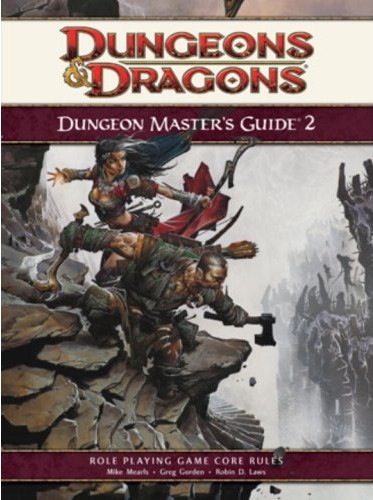
Yesterday was D&D Game Day, celebrating the release of the Dungeon Master's Guide 2. I remain conflicted about the DMG2. On the one hand, I read through it, and it actually has a lot of good advice for running games, especially pointed toward breaking DMs out of the 'standard' mode (long supported by all traditional rpgs) - that of the DM-as-author and players-as-tactical-combatants who also sometimes get to speak a few lines.

On the other hand, I'm aggravated by the slew of extra "basic set" books that WotC seems intent on putting out there. I mean, are we going to have the PHB5? 10? Where does it stop? When will diminishing returns really kick in? I'm finding that my thinking is moving away from the traditional supplement model of rpgs.

That being said, I can recommend the DMG2 for beginner DMs who want to up their game or for anyone who wants to get a lot of solid-seeming advice on how to run games more skillfully. This is not a crunchy book at all - in fact, it is downright chewy. There is a lot in there to think about, particularly if you are new to games, or are stuck in a kick-in-the-door-kill-the-baddie rut.

For my part, I came down to the FLGS here in San Rafael and ran a little module for some eager players. It was a lot of fun, and I learned something. 4th Edition runs really well with three players. I used three of the PCs distributed by WotC for use in games running on D&D Game Day (I let the players choose from the 5 there were) and just altered the encounters I'd set up to accommodate fewer PCs. It was probably the most fun I've had running 4th Edition D&D - about 3 solid hours of fun and no dragging. Lots of ass was kicked.

So I recommend tossing out the idea of the 'classic' 4-PC D&D party for a try. Go with 3 or even 2. I think the game not only works well, but actually better, with fewer players. You can't throw as much at them, and that is it's own kind of fun; I just felt like more happened.

Friday, September 18, 2009

Grab A Cold "Bigby's Crushing Thirst Destroyer" From the Fridge, Will Ya?

Ok, I'm not sure if you can read the pic, but apparently Jones is producing a limited edition of "official" D&D Spellcasting Soda. At ten bucks for a six-pack (plus shipping - I can only imagine) it's on par with the beer I drink I suppose, and could definitely be worth handing out during a game just for the morale-boost. I also can't disparage anyone brave enough to drink Illithid Brain Juice.

Not to mention - whoever it is who squeezes it in the first place.

::shudder::

Sunday, August 30, 2009

Tuesday, August 25, 2009

Pathfinder RPG: Skills and Feats

Skills in Pathfinder are one of the systems that undergo the least amount of change in their new edition. The big exceptions are the additions of Acrobatics, Fly, Linguistics and Perception. (4E combines Climb and Swim into Athletics, which I like)

Acrobatics
Pathfinder combines Jump and Tumble into Acrobatics, basically much as 4E does. This is just some good consolidation of similar skills. You can still tumble around, or through, opponents' squares with an Acrobatics roll, but instead of a set DC, the DC is based on your opponent's Combat Maneuver Defense - something I'll explain later when I delve into system changes.

Fly
Fly is a new skill which is interesting. It sort of makes sense, given the many ways a character might be flying in D20. Basically, you make skill checks to do things like hover or make turns when flying in tactical combat. Fly checks are modified by a creature's maneuverability score, as one would expect.

Linguistics
This is the skill that combines Decipher Script as well as speaking multiple languages. For each rank putinto this skill, your character speaks another language. This will result in characters easily speaking a LOT of languages - as I recall, this is similar to 3.0, where I think one skill rank bought you fluency in a language.

Perception
Perception is just a combination of Listen, Search and Spot, which is a good way to simplify (which 4E also uses).

Next, we turn to Feats.

When I read the Feats section of the Pathfinder RPG, I was surprised at how many there were. There are four full pages of Feats listed in a table much like you found in 3.5 (though it was half as long). Some are genuinely new, whereas others are taken from supplements. A large number of Feats are expansions of combat Feats you're probably already familiar with. First I'll mention a few Feats that are expanded upon (that is, longer chains attached to them), and then I'll pick out a couple interesting individual Feats.

Combat Expertise has 7 Feats it is a prerequisite for, where Critical Focus (distinct from Improved Critical) has 9 in its chain. Dodge has Wind Stance and Lightening Stance as well Mobility and Spring Attack; Improved Unarmed Strike has a total of 8 Feats attached to it. There are also more missile feats, more rooted in Power Attack, and Weapon Focus has 9 in it's 'chain'. (This is good news, considering characters will have a lot more Feats than in 3.5, getting one at every odd-numbered level - giving Fighters a Feat per level, for example).

Arcane Armor Training
There are two Arcane Armor Training Feats, and each reduces your Arcane spell failure chance due to wearing armor. I've always liked this idea, not necessarily buying that arcane spellcasters have any logical reason to be "clothies" other than long-standing convention.

Deadly Aim
This Feat is like Power Attack, but for ranged attacks, which is a cool idea.

Intimidating Prowess
This Feat is a house rule of mine - you add Str to Intimidate checks rather than Cha. This has always made sense to me, since being huge is in itself intimidating, regardless of what your social skills look like.

Vital Strike
This Feat is kind of exciting if you want to just deal out damage. This Feat lets you double your weapon damage dice on a single attack...every time. If you have multiple attacks, then the one at your highest attack bonus doubles it's dice. So that longsword now deals 2d8 if you hit with your best attack, and so on. And yes, you can build on the Feat from there, dealing 3x and even 4x dice in damage with your highest attack.

There are a lot of other exciting Feats in the Pathfinder RPG, but I don't want to go into all of them. Suffice to say, you'll still have hard decisions to make when choosing Feats as you level, and looking through, there are enough Feats to take away the 'obvious' Feat decisions from 3.5's core PHB. This means more versatility and more interesting specialization. I can see multiple Fighter builds, for example, that would be very different from each other, and that in itself is cool.

Sunday, August 23, 2009

Pathfinder RPG: Races and Classes

Let's get right down to business, shall we?

In Pathfinder, attributes are no different from 3.x, but races have been beefed up. Pathfinder, in general, makes characters stronger at level 1 - something Paizo and WotC agree on, apparently.

Dwarves
Dwarves have all the usual weird AC and attack bonuses against giants and goblinoids and so on, as well as their usual Stability ability. The main difference compared to 3.x is that Dwarves get a +2 to Constitution and Wisdom to go with their -2 to Charisma. Their fluff is what it always is - gruff blah blah blah honorable blah blah blah stone and metal, etc.

Elves
D&D's metrosexuals get +2 to both Dexterity and Intelligence to balance their -2 to Constitution. Otherwise, they are generally unchanged in fluff and so on.

Gnomes
Based on their artwork in the book, Gnomes seem to be the sort of zany trickster' race (whereas Halflings tend to be creepy and childlike). Gnomes get a +2 to Constitution and Charisma and the usual -2 to Strength. One additional ability is Obsessive, which gives them a +2 to a Craft and a Profession of their choice. Their fluff is what you'd expect.

Half-Elves
The other metrosexual race gets a straight +2 to an ability of their choice. They also receive the Skill Focus Feat for free at 1st level. Lastly, Half-Elves choose 2 favored classes, and they get the +1 HP per level or +1 skill rank per level bonus when they take levels in those two classes (and that's how favored classes function - you get one of those two bonuses).

Half-Orcs
Oddly, Half-Orces also get a +2 to an ability of their choice - even though all of their fluff implies a lack of Charisma and their art implies a whole lot of Strength and Constitution. Otherwise, they are Intimidating (they get +2 to Intimidate), and they have Orc Ferocity, which lets them fight on at exactly 0 hit points for one round before they are knocked unconscious.

All in all, I think that Half-Orcs get the short end of the stick...as usual.

Halflings
The wee ones are still wee - not the enlarged 4E versions. They get a +2 to Dexterity and a +2 to Charisma and the usual -2 to Strength. They also get the bonuses they did in 3.5, so nothing big that's new here. Halfling fluff has them as scavengers at the fringes of society when they settle down, or nomadic wanderers otherwise.

Humans
Like both half-races, Humans get a +2 in any ability, and their usual extra Feat and Skill rank.

Now, to the classes...

In listening to a lot of interviews with the Paizo guys and reading what they're writing about their work, they had a goal for each class that every level would give you something more than the basic extra HD and so on. Everyone gets candy at every level. You also get a Feat every two levels - but in addition to the Feat, there is still candy.

Oh, good to note - as we get into caster descriptions, all casters (Bards, Clerics, Druids, Sorcerers and Wizards) have 0-level spells that they can cast all day long. This is cool, but I don't want to repeat it :)

Barbarian
The candy that the Barbarian gets is the ability to add effects to her Rage ability, like Animal Fury or Guarded Stance or No Escape (what are these? Buy the book! :). These powers just stack up, so at some point when you Rage, you become a crazy killing-machine. Otherwise, the Barbarian is very recognizeable from 3.5.

Bard
Bardic Knowledge is expanded a bit to make it more versatile, and the end result is that the Bard is the master of Knowledge skills, whether she has ranks in them or not. Bardic Music is also expanded in power and versatility, and the Bard retains her spells. The Bard is one of the classes to get a bump in hit dice, so each level you roll a d8 instead of a d6. As they level, Bards also become masters of using skills untrained, and at level 20, a Bard can kill with her musical performance. Nice.

Cleric
The biggest thing about the Cleric, for me, is the loss of Turn Undead (though it rears its ugly head as a Feat...). Instead, you just channel positive or negative enrgy - if you read the playtest pdf, then you're already familiar with this, as well as the fact that Clerics can use medium armor but not heavy. Another cool change is with Domains - not only do you get the bonus Domain spells, you also get one of two Domain abilities for each of your Domains - and these are cool, colorful, and useful.

Druid
Clerics have Nature's Bond, which gives one option as having an animal companion. The other option is to have a Cleric Domain: Air, Animal, Earth, Fire, Plant, Water or Weather, including the bonus spell and powers associated with it. Otherwise, actually, Druids haven't changed much from 3.5.

Fighter
Fighters get an overhaul and a straight infusion of awesome. They still have bonus Feats as in 3.5, but they also get a Bravery bonus to Will saves against Fear (something I've always wanted). They also get Armor Training, which reduces the penalties for heavy armor, as well as Weapon Training, which gives stacking +1 bonuses to categories of weapons so that at 20th level, a Fighter can use one category of weapon and get a +4 to hit and damage, as well as confirming every critical hit automatically.

Monk
Monks are also very much the same, except they have a ki pool, a pool of points that the Monk can spend to make extra attacks, go faster for a round or dodge for effectively.

Paladin
The main difference with Paladins is that their Lay on Hands gets augmented significantly. Now, when a Paladin uses her Lay on Hands, she also has an ability called a Mercy that takes effect. What the Mercy does is it removes one or more conditions from the recipient of the LoH. A Paladin also has overlapping Auras, each granting her immunity to some kind of supernatural effect and granting her nearby allies a bonus to defend against it.

Ranger
The Ranger gets bumped back up to d10 hit dice, and on top of the Favored Enemes, the Ranger also gets Favored Terrains. The Ranger also has a new Quarry ability, which is a lot like marking abilities from 4E or MMORPGs, meaning the Ranger chooses one target and murders it.

Rogue
Rogues have talents now that at every even level, alternating with Sneak Attack. Talents include crippling and bleed effects, as well as defensive abilities, some culled from 3.5 supplements and some originals like Dispelling Attack.

Sorcerers
Sorcerer bloodlines are expanded upon, and add a lot of coolness to the class. The Sorcerer is assumed to have her abilities because of her ancestry - she has some kind of supernatural blood flowing through her veins, including undead, demonic, draconic or fey. This bloodline gives her specific bonus spells and a few abilities as she goes up in level which are in line with the bloodline.

Wizard
Wizards now get special abilities when they specialize in a particular school, including some kind of at-will basic attack ability which is a nice bonus for the Wizard, particularly at lower levels when you blow those couple Magic Missiles and then twiddle your thumbs in previous editions.

Basically, every class is improved and made more interesting, as well as more powerful. I can only assume the RPG Bestiary will make all these new powers necessary. Pitting these new classes against 'classic' MM critters just seems unfair...

Next up, Skills and Feats

Monday, August 17, 2009

Pathfinder RPG: First Impressions

At 575 pages, this book is a heavyweight in the RPG world. Not quite Ptolus heavy, but a runner-up, up there with Hero, and potentially just as able to stop a bullet.

From the get-go, it's worth noting that Paizo's Pathfinder RPG is D&D 3.5 with some changes. If you didn't like 3.x, you won't like Pathfinder. If you liked 3.x, then Pathfinder is better in pretty much every way.

Layout and design for the book is pleasing but also simple. There's probably art on every 3rd-4th page, and it is the beautiful, evocative artwork that I associate with Pathfinder.

The chapters are as follows:
Getting Started
Races
Classes
Skills
Feats
Equipment
Additional Rules
Combat
Magic
Spells
Prestige Classes
Gamemastering
Environment
Creating NPCs
Magic Items
Followed by Appendices 1-4

As you can see, this book covers the territory of the original PHb and DMG together, making the price-tag ($50) actually pretty reasonable.

Next, I'll be delving into this heavy tome, focusing on races and classes, then feats and skills, followed by combat and prestige classes, then magic and magic items, and finally some closing thoughts. So an Pathfinder-stravaganza. Before you bother to read all of that, though, I want to reiterate - if you like 3.x D&D, get this game. You will like this better, and I have a feeling that Paizo will stick with this for a long time yet before they try any Pathfinder 2.0 crap :)

Saturday, August 15, 2009

How I Made D&D Cooler Part 2: Characters


Here's an example of a character sheet I sketched out for one of the characters in my D&D game:
[Stolen Image from the Internet]

“Cornelius Finch” Lvl 5 Human Huckster of Evil

Str 12 Con 9 Dex 13 Int 14 Wis 10 Cha 17
HP 22 [ ] , Bloodied 10, +1 Leather 2, Initiative +4
Surges 7, Healing 4
Melee +4, Missile +6,
Fortitude 12, Reflex 17, Will 18
Feats: Smooth Talker, Dodge
Special: Extra Skill, Extra Feat

At-Will: MW Throwing Knives +6 (1d4+5) or +4 (1d4+5), Bluff +10, Diplomacy +10, History +7, Insight +6, Sailing +8, Stealth +6, Thievery +6, Default +3, Bardic Inspiration (+1 to rolls and damage), Helpful Anecdote +2


*Encounter: Entrancement +8

**Utility: Suggestion +8

***Daily: Charm +8, Lesser Geas +8


Pretty simple; I'll go through it bit by bit. A lot of this is being familiar with the D20 system and working things out organically. As I said before, this isn't a new system or anything, just a way to play D&D without having fifteen books at the table or having drawn-out rules arguments - basically, beginner-friendly with some Doug-ish twists.

“Cornelius Finch” Lvl 5 Human Huckster of Evil
The class is Huckster of Evil based on the players' description of his character concept, which most resembled a fast-talking, capitalistic Bard. Levels work the same as usual - his level is his number of "hit dice" and is also added to d20 rolls and defenses as it is in 4th Edition.

As you can see, I kept the usual clunky ability scores, where you subtract 10 and then divide by 2 for the actual bonus. This is just a D&D convention that people are used to.

+1 Leather 2
Armor in this version simply provides DR/-, or damage resistance against everything physical. In this case, I divided the listed AC bonus for leather armor by 2 and that was the DR for the armor. Because it is +1 magical armor, I add 1 to that number, for a total of 2. Easy.

Surges 7, Healing 4
Surges, as I said, are a player resource to boost particular actions their characters attempt. They are like a more versatile version of the action points from Unearthed Arcana and the like. The "healing" rating is a flat number that represents the character's rate of recovery from Hit Point loss. I get the number by taking their level and adding their Con bonus - in this case, Cornelius' Con has a -1 penalty because it is a 9. So when he rests for a full night, he gets 4HP back. When someone casts Cure Ligh Wounds on him, he gets a base of 4HP back. When he spends a Surge to have a second wind, he recovers 4HP - you get the idea.

Melee +4, Missile +6
Every character has a base melee and missile attack score, just for ease of reference. In this case, the Bard is trained in either melee or missile, and Cornelius is trained in missile. That means that his melee bonus is equal to 1/2 level + Str mod + Feats, etc. and his missile bonus is level + Dex mod + Feats, etc. He has no combat feats, so the math is simple.

Fortitude 12, Reflex 17, Will 18
In keeping with D20, the Bard has trained Reflex and Will and untrained Fortitude defense. I also used the 4E convention where Fortitude can be modified by either Strength or Constitution, Reflex either Dexterity or Intelligence, and Will either Wisdom or Charisma - that's a cool little rule. So, Cornelius' Fortitude defense is 10 + 1/2 level + Str OR Con mod + Feats etc. and his Will defense is 10 + level + Wis or Cha mod + Feats, etc.

At-Will
For at-will abilities, I include basic attacks, basic (first-tier) Feats, and skills. These are all the things you can do in-game, basically, that will have some set effect on the fiction and that you don't have to pay Surges for.

Encounter
Encounter powers cost 1 Surge to use, and in this case, Entrancement works like an attack against Will defense much as it functions in the 3.5 PHb - you can use it to distract people with your performance. The difference, to make this potentially useable in combat, is that you can use it against targets even if they are threatened. They take a -2 penalty to their first action after the entrancement is broken by taking damage or a bigger distraction elsewhere.

All of the rules for these powers are made up and discussed with the player in question. I take what is in the official books as a starting point and then simplify and streamline what I find.

Utility
Cornelius' Utility power is Suggestion, and costs 2 Surges to use, like any Utility power in this system. This is also similar to the 3.5 PHb, and can have you "suggest" anything short of suicide.

Daily
Cornelius, at level 5, has 2 Daily powers, each of which cost 3 Surges to use. The first he's always had - Charm is basically Charm Person - the target becomes your best friend for a scene. The second is the new one - Lesser Geas. The player specifically requested an ability to create magically-enforced contracts to function in his scam-artistry. Again, much like what is in the books.

The way I work out how many Encounter, Utility and Daily powers a character has is pretty simple, and I use 4E as a starting-point.

1st Level: 1 Encounter and 1 Daily (and technically, here, if you use the Daily, you won't have enough Surges to also use the Encounter unless you earn one...)
2nd Level: 1 Encounter, 1 Utility and 1 Daily (and again, you have to choose, since you only have 4 Surges to start a session)
3rd Level: Move one power down on the list and replace it with another - usually move an Encounter power down to At-Will and add a new Encounter power
4th Level: 2 Encounter powers, 1 Utility and 1 Daily
5th Level: 2 Encounter powers, 1 Utility and 2 Daily
6th Level: the character automatically gets a "Prestige Class", and gets the new abilities from that class

And so on...I haven't gone past level 6, but you hopefully get the idea.

In playtesting so far, this sytem has led to much faster-paced D&D games with a lot more happening. I also really enjoy having social powers, particularly in Cornelius' case, so that a player-character can kick ass between fight scenes. Who enjoys being schooled by the local magic item salesmen at level 10? If one character can kill dragons, another should at least be able to win arguments...

Friday, August 14, 2009

Pathfinder RPG


Just picked up the Pathfinder RPG. At least one review will be forthcoming...

Thursday, July 30, 2009

Game Addiction Therapists Treated For Addiction to Gaming

This is the real headline: "Therapists Join World of Warcraft to Treat 'Addicted' Players."

The story is that a group of therapists are asking Blizzard for free access to WoW to search for and identify people addicted to the game. This is because, they say, that true addicts are hard to reach by other means since they are always in their rooms.

While it is no doubt, well intentioned, I couldn't help but see this as a situation ripe for parody. It will probably start well, but 6 months down the line this is what I predict:

Therapist: Die! crazy cat lady die!

Assistant: Dr. we've received an email from another concerned parent...

Therapist: Shhh!!

Assistant: Yes but...

Therapist: Shhh!!! I told you not to bother me when I'm raidin... fuck. Another wipe.

Assistant: I know, but I thought you might be interested, this seems like a serious case.

Therapist: Do you know how many times we've tried this fight? She's one sadistic little...

Assistant: The kid's name is Ryan. His character on your server is a Tauren Druid named Wowzalot. His mom says he has been playing about 17 or 18 hours a day lately.

Therapist: Fine. Fine. Make up a file and put it on my desk. I'll go over it after... did you say a Druid? What spec? We could really use a tree in our raid!

Assistant: I don't think that's what his mom had in mind when she asked us to help intervene.

Therapist: Yeah, probably not. Oh well. Listen we'll have to talk about this later, the group is reforming, gotta buff up.

Assistant: Sir...

Therapist: What!?! I told you we're about to start again!

Assistant: Don't you think you've been playing a little bit too much lately...

Therapist: Don't start that again! I pay you to answer phones, not to be my personal nag.

Assistant: Okay...

Therapist: Here we go! Bitch is goin' down this time! Ayaaaaaaaghghhh....

Tuesday, July 21, 2009

Dual Posting: A New Idea

Pam and I did a lot of driving today, going to church and saying goodbye to friends and hanging out with others who needed some support. Basically a half tank of gas all told, from home to Berkeley to San Jose to Oakland to SF back to home. Long day.

Sometime during that driving, between the bathroom breaks and caffeine binging and arguing about directions, Pam came up with a terrible, wonderful idea that I expanded upon.

I and a friend from seminary open a gaming store in Portland, something we both have wanted to do for a long time. Then, we also start a church, and we rent space in the storefront to the church.

I've always wanted a storefront church in an urban area - its one of the things I've pictured for a long time when I've thought about where I will end up in ministry. I've also wanted to run a game store since I was about, I dunno, 13 or so.

I've heard it called "tentmaking", and when I talk about this plan, people tell me that I really light up. And I feel lit up. There are a lot of downsides, but I've talked to the friend in question and he really likes the idea so far. I want to pursue it, at least to see how far it goes.

Part of me thinks the following: statistically, no matter what we do, 80% of the seminary graduates in the PC(USA) this year will not find first calls because there are five times as many seminarians graduating as there are first calls. So what the Hell else are we supposed to do? We need to get creative, because the denomination is cranking out seminary graduates at five times the rate it can absorb them. This hardly seems like responsible stewardship, but those sour grapes are old at this point. They're basically w(h)ine. So I need to figure something out, since in the numbers game of first calls, I'm screwed.

I wonder if there is any support for an idea like this in the denomination? I know money goes to new church developments, but I also know they say I need 5 years of ministry experience before I can be an NCD pastor. Well, where am I supposed to get those 5 years?

Running a game store and storefront church in Portland, that's where.

Sunday, July 12, 2009

How I Made D&D Cooler Part 1: The Basics

In planning to run my current D&D game, I had a few things in mind.

1. I didn't want to spend more time preparing for the game than playing the game in a given week.

2. I didn't want to spend multiple sessions teaching the players how to play their characters effectively.

3. I didn't want to use a battle mat or miniatures, but wanted action to flow quickly while still retaining some tactical detail.

4. I wanted there to be special abilities for things aside from combat, like movement and social interactions and information-finding (much like we've working into Heroes of Karia Vitalus)

In achieving what amount to game-design goals working with the skeleton of D&D, I decided to do a few general things and then work each until the details became clear. The first and most complicated of these was simplification - taking the rules and simplifying them, tossing out the necessity of a battle mat and miniatures, and boiling down the hundred-thousand variations on the rules into a few general principles.

The second, easier process was diversification- taking what I'd simplified down and working on it so that it represented what each of the players wanted to play and do with their characters.

Here's what I mean.

Simplification
The first think I decided was that there would be two kinds of abilities: trained and untrained. Trained abilities would be level + attribute modifier + other modifiers, +10 is it was a passive ability and + d20 if it was an active ability. Untrained abilities would be 1/2 level, but the rest would be the same. This counts for spells, saves, defenses, attack rolls, skills, everything.

I dropped Armor Class entirely and just used Reflex Defense in its place, adding 1 for a small shield and 2 for a large shield, and factoring in armor penalties from the 4th Edition PHB. The effect armor would have would be to reduce all incoming damage in the amount of 1/2 the armor's listed AC bonus + any magic modifier.

I wanted to add character level to all damage rolls as well - I've found that in 4th Edition in particular, but in any high-level D&D, characters and monsters can pound on each other for hours while they whittle down Hit Points with no discernible in-game effect.

Healing Surges became just Surges, and they were melded with Action Points (allowing adding 1d6 to a d20 roll). I also added an indie game twist stolen from Mouse Guard - you can spend a Surge to succeed with some kind of consequence chosen by the GM. I've gotten a lot of fun and mileage from this already, and like the rule a lot.

I kept At-will, Encounter, Utility and Daily powers from D&D 4E but changed what they meant. At-will powers cost nothing, and include skills, basic weapon attacks and some basic feats. Encounter powers cost 1 Surge to activate and include basic spells, class or racial abilities, second-tier feats (with one pre-requisite, say). Utility powers require 2 Surges to activate and include a lot of movement, social and information-gathering abilities, as well as abilities related to traveling more quickly than usual. Daily powers cost 3 Surges to activate and represent more advanced spells, feats with many pre-requisites, and other powerful abilities.

For abilities I just made up, I used as a rule of thumb 2d6 damage for an Encounter ability and 3d6 for a Daily ability, though I might change this so that it is higher.

Characters start a session with level + 2 Surges and can earn further Surges from the DM by doing interesting things in-game.

I decided to give spells attack rolls like in 4E against the appropriate defense. I also split melee and missile proficiency, since I liked the idea that some classes would be better in one or the other. Fighters, Rangers and Rogues are trained in both melee and missile. Barbarians, Clerics, Druids, Paladins and Monks are trained only in melee. I made it so that Bards could choose to be trained in either melee or missile, but not both, and Sorcerers and Wizards are untrained in both. I also added spellcasting as a trained or untrained ability, to represent pure casters and hybrid casters. Paladins and Rangers are untrained but can still cast spells. As usual, Barbarians, Fighters and Rogues cannot cast spells at all. Bards, Clerics, Druids, Sorcerers and Wizards are trained of course. This means that Paladins and Rangers will be able to use support abilities, but won't be able to make attacks with pure spellcasting most of the time except against weak opponents - this made sense to me.

I gave each character a healing rate (or "stitch" rate for the one undead PC) that is equal to their level + Constitution modifier. This is the amount they heal when they take a "second wind" (which costs 1 Surge) in combat or when they have a night's rest. They heal double that amount when they have a full-day's rest (which of course never happens in D&D). Healing spells like Cure Moderate Wounds use this system - Cure Moderate Wounds heals 2x a character's healing rate + any bonuses the character has to healing spells.

I kept the Bloodied condition because I like the idea, and decided that similar to Vitality and Wounds from Unearthed Arcana 3E, when you became Bloodied you would be Fatigued or, if already Fatigued, Exhausted, until you received some kind of healing (even if it doesn't bring you back up over Bloodied).

Diversification
In this particular game, I had a few unusual characters (which is part of what I enjoy). One of them is an intelligent Ghoul. Another is a Ogre Barbarian, and a third is a Human Bard who has a number of social powers but none that are really useful in combat (the kiss of death in most D&D games).

I also had some more "normal" characters like a Halfling mage-thief, an Orc Cleric and a Human Necromancer. These were a lot closer to what you find in the various books and supplements, and were relatively easy to come up with.

The most interesting for me was the Ghoul, and I think that'll be my first example in this series. Her name is "Mr. Scram" (I'm not sure why this female Ghoul is a "Mr" but oh well) and she is actually the Human Necromancer's mother - he raised her out of loneliness but she turned out to be more intelligent and willful than he wanted, and now nags him from beyond the grave.

I decided that the Ghoul would be like a zombie from Dawn of the Dead or 28 Days Later, fast and grabby and bitey and really hard to bring down. It didn't make sense that she'd wear armor, so I gave her d12 hit dice and a high Cconstitution as well as a trained Fortitude defense and melee attack. I made her claws and infectious bite (3E MM) At-will powers, along with trained Endurance, Intimidation and Stealth. Her Encounter power has been her Paralyzing Stench (3E MM again). Her Utility power is Creep, which I invented. Basically, it lets her crawl along walls and ceilings in a freakish way like critters do in horror movies. Her Daily powers are Devour Flesh, which I invented (she eats living flesh and heals 3 "stitches" as well as cancelling ongoing negative effects) and Bilious Blood, also made up for her (when hit for an encounter, she deals 5 acid damage to her attacker).

Conclusion for Now
This is definitely a way of running D&D that is a lot of fun (more fun than "real" D&D as far as I am concerned, and the players seem to feel similarly) but I couldn't actually write up in a book or something. This is very much my project achieving my design goals - the best thing these posts can be is a sort of rough blueprint for other people whose friends want to play D&D but who don't like how much D&D bogs you down.

Next up: Using the Ghoul as an example character and looking at some more details.

Monday, July 6, 2009

What's Cool About D&D?


I've been running a D&D game for a couple of sessions now. About half of the players requested D&D, but honestly I think that D&D is too much damn work to teach and prepare for when dealing with relatively new players. I pictured session after session of pawing through the books and looking at power cards (if I dropped the cash to buy them that is, or printed them or whatever) and for a game that'll only span a half-dozen sessions, that was an apalling thought.

So what I did is I tried to boil D&D down to what I like about it, a simple enough system to teach quickly and easily, mixing what I liked about 3.x and 4e with some of my own additions. Frankly, I think this game might ruin some of the players on D&D forever, because in a session we get through a lot more play than is usual in D&D - and we don't need to use a battle mat or miniatures.

I want to talk about what I've been doing for this game, in case anyone else wants most of the coolness of D&D with about 30% of the work. To begin, I want to think about what is cool about D&D, at least to me, that I had in mind when I designed my hack/drift. When thinking about this coolness, I have in mind my own experiences playing D&D, AD&D, D&D 3e, D&D 3.5, D&D 4e, and any number of computer RPGs based on D&D since VGA graphics were cutting-edge.


What's cool about the Races?

I don't think much has to be said here. We all have, firmly implanted in our minds by any number of "high fantasy" games and books and movies out there, what the stereotypical races are like. The alcoholic Dwarf; the aloof Elf; the semi-trickster Halfling. And so on.


What's cool about the Classes?

I think 4e had a number of chances to get this right, and they did sporadically. I'm going to stick to the 'classic' 3.5 classes for this, though, looking at what I like. I also mention pitfalls I've seen over and over again associated with each class - what players do with them that, frankly, sucks.

What's cool about the Barbarian is being an angry heavy-hitter, crashing your way through foes, almost impossible to bring down even though you're peppered with arrows. Its also fun to be the primal character from the wilds, scowling at the comforts of civilization.

Barbarian pitfall: Some players take the "Rage" ability as their sole roleplaying hint, and that can get pretty damn tedious.

The Bard is cool, when the Bard is cool, for being a support class. The Bard makes others more powerful. The Bard has always been the most versatile class - some spell abilities from divine and some from arcane casters, some musical abilities, a few Rogue skills thrown in. Lastly, on the rare occasional when social skills matter, the Bard is king (or queen).

Bard pitfall: Players who sing everything and act like douches. Also, with the Bard, its hard not to end up as the guy who does everything, but doesn't do anything better than the other PCs.

The Cleric has always been cool for the powergamer. Clerics have always been overpowered, and every group needs one. Clerics lay the smackdown on undead and are basically impossible to kill.

Cleric pitfall: Like I said, the Cleric has always been overpowered. 4e tried to solve this by making the Cleric uninteresting, and this was not quite a win I'm afraid. Its also sort of hard to justify the highest experssion of a religion being plate armor and a blood-stained mace.

A Druid is cool by being the caster version of the Barbarian - the interloper from the wilds, but this time with more teeth. The Druid is a ferocious act of nature, and very versatile with shapechanging, spellcasting, and their animal companion.

Druid pitfall: The Druid has a similar pitfall to the Cleric, though some restrictions on their armor and weaponry help. Druid players also often end up having their characters never set foot in a city, meaning they are pouting whenever the party goes to the city to do the usual tavern-wenching-and-buying-stuff.

Ok, the Fighter's claim to cool is easy. The Fighter is the indomidable force on the battlefield. It is cool to play a fighter, to have an opponent throw everything he has at you, and when the smoke clears, you're still standing.

Fighter pitfall: the Fighter is often the new player's starter character, named Fi-tor or something (with thanks to Fear the Boot), who sulks in the corner until there's a fight, then stomps around and makes basic attacks.

If you can't see how the Monk is cool, you're a lost cause. If Jet Li and Jackie Chan and Michelle Yeoh are cool, then the Monk is cool. It is cool to leap across the room and plant your foot in someone's face. It is cool to slip unarmored and untouched through the battlefield.

Monk pitfall: often, monks haven't kicked enough ass. I've played plenty of Monks who just didn't stand up in combat. They have other cool skills, but also tend to have low hit points, since they need Strength, Dexterity and Wisdom to get by. We'll see if 4e fixes this.

Ah, holy Paladin. The Paladin is cool for kicking the asses of evil critters everywhere. It matches with ides of the mounted chivalric hero. But there's a big pitfall to go with that.

Paladin pitfall: a lot of players play Paladins as complete self-righteous douchebags. I think we have "classic" D&D to blame for this, with the Lawful Good restriction, but honestly, I think that the Paladin just attracts dick players. Just my experience.

The Ranger is cool on the trail of his quarry, hunting something down and filling it with arrows, then finishing it off with some two-weapon work. For some reason, I think of Last of the Mohicans when I think of the Ranger.

Ranger pitfall: I'm not sure there is one. The Ranger is what it is.

In many ways, the Rogue exudes cool. Slick, invisible, agile, and deadly. Good times.

Rogue pitfall: there's something about the Rogue that encourages players to steal from other player-characters. That is aggravating as fuck. Stop it.

Sorcerers are cool as an alternative to Wizards for people who don't want quite as much book-keeping but who still want the fun of the arcane-casting powerhouse.

Sorcerer pitfall: again, not sure there is one here. Most Sorcerer-types I've seen played are pretty cool.

Wizards are cool - they got game like Gandalf. I think that, generally speaking, D&D's magic system has always been apallingly bad, but given that, the Wizard is the geek of high fantasy.

Wizard pitfall: page-leafing. The book-keeping for a Wizard player is astronomical, and you really need to be the kind of person who likes that. To me, t hat's what makes the Sorcerer so key.


What's cool about the Magic?

If you can shut down your frontal cortex and accept D&D magic overall, the only real cool thing about it is that it is like a toolbox. It doesn't require much creativity or invention at all - you look at the spell lists like a menu and pick what looks cool to you.

In my experience, this means that 90% of the spell lists in even the basic PHB are never touched. 4e has addressed this to some degree...by cutting 90% of the spells and then expanding iterations of the ones that were left.


What's cool about the System?

The best the system does is when you treat it like a miniatures wargame. If you like sliding around a checkered map, D&D is obviously the game for you. If you want to do anything else, you need to drift the rules - in 3e drift a little, in 4e drift a lot. You can check out my other posts on this topic to get more of my views.

For a roleplaying game, you will probably spend the most time in D&D doing things you don't want to do, or checking out because it isn't your turnin combat. My last session, there were three conversations going on and two players were playing with a dog during the big combat finale. This is not changed at all in 4e - at last not in the first half-dozen sessions or so.

What I like about the rules is the places where it attempts to simulate, in detail, combat situations. It does so, and has always done so, inelegantly and with dizzying complexity of jargon and rules, but I respect the attempt.


So, that's that. What do you think is cool about D&D?

Next up, what I did to change it, and why.

Thursday, July 2, 2009

Horror RPG Module Challenge!

What we have at the core of Horror! is a really, really simple system of comparing numbers. The higher number wins. The lower number loses, and then the character with that number gets some kind of penalty for losing - Fear, Pain, a setback, or just lost time against the ever-looming Countdown.

This is why I think it is easy to make modules for Horror!, even when they will require a lot of improvisation and quick thinking, and even when what you're mostly interested in is coming up with background and fluff and story.

Attributes range from 1 to 5, and Traits, on average, will add +1 or +2 in rarer cases to that number. Y ou can assume that a given character, after the beginning of the game, will have at least a little Fear and Pain, meaning the penalties from those (-1 or -2) will often cancel out the Trait bonus the player might be able to come up with, leaving the 1-5 range again.

Basically, just create a flow-chart of how hard you want the session to be based on that range. So...

Don't do anything that is a target of 1

A target of 2 is a throwaway, should be the minimum you'd ever set for anything that's worth calling a test

A target of 3 should be standard for someone doing what they do for a living, but still isn't much of a challenge

A target of 4 is a bit of a challenge

A target of 5 will require that most characters go looking for help, either in the environment or from another character

A target of 6 is a way of saying "don't do this" - any character will need to call on help, Adrenaline or Virtue, a Trait, something to even the score, especially if they have already gotten some Fear and/or Pain. The 6 is "big bad" territory, because on average, characters will go down unless very well prepared.

A target of 7 is a good maximum. That's what a healthy character using their Attribute of 5 and doubling a Feat or Influence with an Adrenaline or Virtue respectively can hit

As always, feel free to just say "you can't do that, try something else". Horror! is not a game about "say yes or roll the dice" - and not just because there are no dice.

So what did I do?
I used the target numbers as a pacing mechanic. Like the countdown, they should escalate as the game progresses, so things become harder and more threatening as time goes on.

The scenario I'd sketched out in my mind placed the PCs in a secret installation beneath Tibet, a huge particle accelerator built by the Chinese government, designed to crack open quantum theory and prove or disprove string theory. What happens is that the first experiment is a success - and the PCs are part of a group splintered off into an alternate mini-dimension, forever disconnected from the "real" world - set adrift.

Everything begins to become unhinged - mechanical and digital systems, the characters' memory and sanity, even gravity near the end, as this splinter dimension 'forgets' how it is supposed to function and spins down rapidly to entropy. Others on the station have figured this out and are overcome with despair and begin killing each other and themselves. Each of the PCs comes to, suddenly having a moment of clarity in the midst of either committing suicide or killing someone else. They briefly 'reset', forgetting some of what has happened but also being able to think clearly. So each of the characters start in the midst of something awful and then go on to figure out what is going on from there, while the clock is ticking and everything is going apeshit around them.

In the beginning the targets are around 2. One PC comes to locked in mortal combat with a crazed old man trying to drive a syringe into his eye; another in the midst of hanging himself, a third locked in her room being suffocated in her bed. They get out pretty easily, begin to get a handle on the system, etc. This is kind of like the Prelude.

Act One has mostly target numbers of 3 or 4. This includes seeing the first dead bodies, or people dying, in horrible but relatively 'mundane' ways, as well as changing locks and that kind of thing. Stuff that a skilled professional can do, or someone with a strong stomach can tolerate (humorously, two player characters had Conviction as their dump-stat of 1 and got Fear from everything).

Act Two, in my mind, starts involving the really messed up shit that is at the heart of everything - they find out much more about the awful situation they're all in, they see the piles of bodies, etc. This is where targets of 5 and even 6 come into play, where everything starts to hit the fan. The Countdown should be low at this point, and ideally everyone is sweating bullets.

Act Three is when the Ace of Spades comes off the table and things escalate before the inevitable end. These target 5 and 6 tests come at you one after another, and even a 7 here and there to push people in the right direction and let them know that even if they work together and have some Traits, they can still fail.

For each of the Acts, I had what I called a Pressure Menu (yeah, I know, I need a better name). On this menu, I just listed bad things that I can have happen to push things forward. A guy jumps out of a doorway screaming and leaps on one of the PCs. They find out X scary information. They find a trail of blood leading to a person who is in the last moments of suicide - someone they know, care about. Etc. Then, if I feel myself getting bored, or antsy, I have one of these things happen and slap a couple of numbers on it appropriate to the approximate "Act" I'm in .

What if the players skip ahead in my story?
Take off a card and escalate things to the next Act. Do the exact things you'd already planned, but increase the target number by 1 or 2. Presto! Drama and fear ensue.

What if it takes too long?
Same answer as above. When in doubt, escalate.

What if I set the Countdown wrong?
It only has to be as regular as you want it to be.

What if they go off the rails entirely?
Take a moment to look at the obstacles you've set up to put in their path. Which ones can just be moved to the new location? Zombies and security doors and so on can come up whenever, frankly.

Then find the things that won't fit and change the fluff, leaving the obstacle there and about as bad as it was. If it was one named NPC, make it another named NPC. If it was a physical threat, make it another kind of physical threat.

Plan everything so that the PCs die horribly.
Put enough tests in there to wear them down entirely. Balance things against them. Make the Countdown account for about 1/2 to 2/3 of the expected length of the session. Escalate things early and capriciously.

The players are signing up to see their characters die and go insane in delicious ways. That's what this is all about. It is not about triumph (though sometimes the PCs may do just that). It is about doing terrible things to each other's characters and enjoying every minute of it. By the time the last card comes up off the Countdown and the game ends, the players should be on the verge of getting out alive, or have some hope still glimmering, and then you stifle it forever.

That's horror.

Fear Rating
Most psychological tests, involving Conviction, will occur when a PC encounters something awful. Just set a number for these tests like you would any other - and make sure to include some 5s and 6s to that everyone can enjoy the fun...
2 Seeing something very frightening but within your normal experience - like watching a car accident
3 Something possibly a little traumatizing, like seeing a car accident when someone is thrown through their windshield
4 This is bad, bad stuff, like seeing someone killed and their severed head falls in your lap, staring up at you, and blinks at you before all of the blood drains out
5 Heinous crimes at the limits of what you can imagine a person doing - like being caught in the The Cell or seeing the Wolf Creek guy at work on a loved one or two
6 You really are a sick fuck. Nice job.

Tuesday, June 30, 2009

Horror RPG Feedback

As I mentioned before, I recently ran a playtest of our Horror! rpg, and I wanted to go through the feedback I got from the players and then talk a bit about what I'm going to do with it. Hopefully my previous post about the basics of the system will help a reader follow along, but this is also just a chance for me to put my thoughts out there (and maybe get some discussion if there are interested readers).

I'm focusing on negative and critical feedback here. The vast majority of what I heard was "this game is awesome!", but the critical stuff is what will be most helpful going forward, as anyone could expect.

Notes from looking at the character sheets

One thing I was sure to do was save the character sheets, and to look at what parts the players used most, what they wrote on them as notes to themselves, that kind of thing.

Overall, the character sheets, though basic, were used the way I intended. The Traits section wasn't used very much or very well detailed out, but that I connect with the fact that we're not so clear on it either. One player drew arrows between the descriptions of Adrenaline and Virtue connecting them to Feats and Influences, respectively. So these need to be closer together (and there need to be headings on the character sheet for each section that coincide with the headings on a book). I also notice that when a lot of Traits are chosen in one category, people run out of space to write quickly.

My notes as GM

I also took notes for my own use. The first thing I did was flip over my typed up scenario notes and sketch out a mini character sheet for each of the players on the back. I realized I'd need to know their Attributes, and also added their characer names and archetypes with player names at the bottom.

Under each of these mini character sheets, I also listed NPCs connected to each character - just name and a couple of words were all I needed. At the bottom of this while page (which was what I most often looked at during the game as I recall) I wrote "needs to be a reward for awesome!" There were cool things that one player expeciall did that didn't really fit under Adrenaline or Virtue. Maybe a random card dealt to them? But I'd like there to be some kind of reward, and what we have didn't quite fit.

I made a note to myself that every card on the countdown should represent about 15 minutes of game-time. The way it turned out, by the way, was about 150% of that estimate, and this might be a normal thing - we'll have to find out with more playtests.

Player feedback during character creation

One player used a Feat to resist things like intimidation, since it made sense to them...and it sort of made sense to me, since Adrenaline would help you resist being bullied. So maybe Feats should be broader than just physical...

There was confusion about the main attribute for each archetype, and I'm ok with dropping it, or just having it as a suggestion. Everyone expected it to have an in-game effect, and when it didn't, it seemed like a wasted idea.

Player feedback during the game

The players reacted strongly every time a card was taken away from the Countdown. I think I should draw more attention to the event, though, and the phrase I saw to help escalate things, since a couple of times it was actually missed, and a player said "Wait, we lost a card when I wasn't looking!" I want it to be a "gulp" moment, not a "huh" moment.

One player had the cool idea to give their own character a level of Fear in exchange for some kind of temporary benefit. This came up when a player was frightened and sickened and wanted their character to be frightened as well. Wow! I want to reward that kind of thinking! So maybe an Adrenaline when you give yourself a level of Fear and a Virtue when you give yourself a level of Pain. Actually...nice.

Player feedback at the end debriefing

Organized by the questions that I asked:

Were you ever scared? Anxious? Nervous? When?

FUCK YES! Player creepiness helped, th GM's vivid descriptions of creepy things, and when there was no solution or no way out in a tight situation

Were you entertained?

Yes!

What was the coolest thing a player did?

One player had his character throw down his gun when he finally found one. Another player was totally nonplussed by most of the horrors going on around her (this creeped me out a bit as well). Lastly, players physically role-played some of their characers' actions - and this is something else I want to reward somehow.

What do you wish your character could have done?

It was hard for some to figure out how to use the Traits in-game. I hope this won't be the case when we work them out more clearly in the future.

Where were you most bored or disinterested?

Some people got caught up in cross-talk, and missed details. They didn't like something that is my personal style, which is getting one scene running along via player interaction and then turning to another scene to engage the other players. The vote seemed like the players in this game would prefer a clearer situation where if the group splits (and in a horror game they should) and some of the players become the audience, and then the focus returns to them. That way, no one misses anything.

What was your favorite aspect of the system?

Everyone loved the Countdown mechanic and the cards for character creation. They also liked the open-ended definition for Traits and having physical cards on the table and in their hands representing their Adrenaline and Virtue.

What on your character did you never use?

Feats, Contacts and NPCs that they were connected to in character creation (my fault, honestly), and Hopes - which guided the players' idea of their character and how to play them, but didn't come directly into the game system-wise.

Anything else?

Some of the players said that this game needs a good GM to go well, that it relies too much on improvisation and wouldn't be possible to run from a module. (This led to the challenge I took on that I'll sketch out in a future post)

The players also felt there wasn't enough use of Virtue - the idea came up to have rules written in small print on the character sheet, which really helped when I ran Mouse Guard (thanks Luke Crane for creating a game that can almost fit on two pages!) so I think it is definitely worth a try.

Lastly, the players wanted it to be clear whether they would be basically collaborative or basically antagonistic. It wasn't clear at the beginning, and it led to some confusion with some players assume they should be suspicious of the others and other players trying to work together to get out alive. This might need to be something that is laid o ut clearly at the beginning of the session, since Horror! can definitely handle PvP.

Sunday, June 28, 2009

The Basics of Our Horror RPG

Before I start talking about this thing, I need to give the basics of the system, which is pretty easy to do. The system has no dice. You just compare the number representing your character's salient ability to the number assigned to how difficult the thing you're trying to do is, and if you're over, you win. If you're under, you lose. If you tie, then there is either a stalemate, or you both win and lose, whichever is more interesting.

You start by choosing your Archetype and your Subtype. The archetypes are taken from our thinking about horror as a genre - what kinds of people get caught up in a horror story? we came up with the Innocent, the Foolhardy, the Jaded and the Victim. Your archetype is important because it determines how many Hopes and Scars you start off with, as well as how much Virtue and Adrenaline one starting Virtue per Hope that you have, one starting Adrenaline per Scar you have. Hopes are things you Hope for, Scars are bad things that happened to you that still hurt you.

There are four subtypes under each archetype, and each subtype has one once-a-session ability that only they can use. This ability will hurt a PC in some way but benefit your character or your player agenda in some way. They are all different, and are still in rough form, but that's the idea behind them.

There are four Attributes in this game - Might, Precision, Appeal and Conviction. Might helps you pass physical tests; Precision helps you pass technical tests; Appeal helps you pass social tests; Conviction helps you pass psychological tests. Physical tests are usually about avoiding or inflicting Pain. Technical tests are about overcoming obstacles in the fiction. Social tests are about getting NPCs (and PCs if you go PvP) to do what you want. Conviction is about resisting social influences from others and about resisting Fear.

Fear and Pain are what destroy your character. If you accumulate 4 of either, you go for a side talk with the GM and your character is subsumed by the horror, whatever it happens to be - or possibly just insane or dead.

Adrenaline, mentioned above, helps you resist your own Fear and Pain (which impose penalties). Virtue lets one character remove another character's Fear or Pain - nothing else in the game does that. You get Adrenaline for kicking ass and Virtue for putting yourself in danger on behalf of others and that kind of thing.

Lastly, there are Traits. You have six kinds of traits, and they modify your Attributes in a test, usually by +1. Feats are physical abilities that you have, ways you can push your body to do amazing things. Influences are social abilities you have, as well as friends or allies or contacts you have that you want to be part of the game. Items are things you have with you when the game starts - they are a contract with the GM, because if it isn't on your character sheet, there is no guarantee that you'll be able to use it in the game. Knowledges are areas of expertise. Once per scene, you can ask the GM a question in your area of experties (if in the game you have the opportunity to sit and reflect, do a little research, use a lab, etc.) and the GM has to give you an honest answer. Mysteries are the wild card Traits in the game that we are still working out - things like ESP or telekinesis, knowledge of alien abductions and conspiracy theories, or occult abilities. Mysteries are very versatile, but when you call upon one, you risk increasing your own Fear. Last are Skills, which are just like skills in every other rpg.

Each Trait functions differently, but they're all pretty simple. They either let you do something, let you introduce something into the game, or give you about a +1 on specific kinds of tests. That's about it.

What drives this all is the Countdown. The Countdown is represented by some cards on the table (right now) and it functions to keep the pressure on the PCs. As cards are taken away from the center, they know that death and disaster is looming closer, but they don't necessarily know why. The Countdown can represent anything - time until the full moon, how much air is left to breathe, cultists completing a ritual to summon a dread deity, how many campers the slasher goes through before he gets to the PCs - anything. It is the screws that you put to the player's thumbs. The only ways to buy time are 1. take a risk once you've figured out what the Countdown represents or 2. do something awful to someone else - push another camper in front of the slasher, suffocate someone so they don't breathe your air anymore, kill one of the cultists in cold blood, etc.

That's the basics. Now some analysis.

Saturday, June 27, 2009

Dual Posting: A New Discipline; A New Escape

I recently posted a new discipline I'm taking on - I'm going to try to write one poem per day in the next couple of months or so, totaling 60 poems in all. Then I'll reflect on the experience and decide if it is something I want to do long-term.

Fair warning, I cannot guarantee any kind of quality if I'm writing one a day. Frankly, most of them are likely to suck. But if you want to follow along, I'm posting them all here, and might dual post some of them on this blog as well. I don't post about it often, but creative writing, prose and poetry, are both big escapes for me, and always have been, so it might be a nice little change from so much game design talk.

Anyway, back to your regularly scheduled game design talk.

Thursday, June 25, 2009

Horror!: Fantastic Playtest

I am so happy and giddy right now. I just finished a playtest of Horror! including character creation and then about a two-hour scenario sketched out ahead of time and then improvised. I went in with a premise but not knowing what kinds of characters the players would create.

Character creation went really well - a little slow in parts, but I didn't print enough rules handouts for the group, and that didn't help at all. I want to write a post in a few days about what went well, and some feedback I got in the character creation department.

The session also went well. They were actually frightened, disgusted, and felt despair. Hooray! That is exactly what this game is shooting for, and it delivered.

The big challenges now:

Integrating the feedback (which was wonderful and very helpful) on character creation, the game system, and how I the GM applied the game system. I'll sketch this out in the next post.

Writing into the game what I do, what another GM might do - particularly my friend Arnold's challenge - how to make a scenario like this into a module, when so much of it hinged on improvisation? I think that the Horror! system works specifically well at doing just that, but now I have to prove it. So at least one post will posit this idea of a meta-module for horror games using our system. We'll see if it works...