Saturday, December 18, 2010

Review: How We Came to Live Here


With apologies to Brennan Taylor - this is far later than I'd originally hoped.

The very deserving 2010 Ennie nominee for Best Writing, and the game that I personally voted for in that category, is How We Came to Live Here by Brennan Taylor through Galileo Games.  Here's the blurb that goes with the game:

"The People have emerged into a strange new world, a world ruled by monsters. They must carve a place for themselves in this hostile place. Tell the tales of mythic heroes facing the threat of terrible monsters from outside, while at the same time finding their way within the strict rules and expectations of their family and their village.

HOW WE CAME TO LIVE HERE is a story-telling game which evokes the myths and legends of the Native American people. Within the game, characters must navigate their own ambitions and desires, the conflicting demands of their fellow villagers, and the ever-present threat of monsters and natural disasters from outside: Your own ambition could lead you down a path of corruption."

First of all, I like what HWCTLH attempts to do, which is to set what is essentially a fantasy game in something other than pseudo-Europe.  As I said, Brennan Taylor was very much deserving of his Ennie nod for Best Writing on this game, which is lucky, because for the most part, when I buy cool indie games, it is with the understanding that I may never get the chance to play them.  The writing style isn't flashy or over-eloquent, it is simply direct and appropriate to the game.  I don't personally know a great deal about Native American mythology and culture, but what the game text does very well is to evoke a way of viewing the world, from the use of names on up, that is very different from modern America.

As with last time, I want to point out three things about the book that I thought were great, and then at the end point out any weaknesses that I thought I saw.  Because I am a gamer and a writer, I am going to talk about aspects of the game I like as well as aspects of the way the book is written that I like.

Opening Fiction
Lots of roleplaying games begin with a bit of fiction - White Wolf is kind of famous for this, but many games do it, and almost universally this is a poor use of space in the book.  Game fiction is nowhere near at the level that basic genre fiction is most of the time - it is at best a step up from read-aloud box-text in your average adventure module.  This is likely because the skills required to write an engaging instruction manual (which is a lot of what games are) and the skills required to write an engaging story are similar but distinct.  It's definite possible to be good at one and not the other.

HWCTLH begins with the mythic story, briefly told, of the first four worlds.  the game is about stories told in the Fifth World, after all, so one immediately wonders - what came before?  I don't know a lot about Native American mythology, but I have read some myths and stories and poems in translation, where the particularities of syntax are retained, and I think that Taylor does a good job of emulating this.

To make a 'story' short; I actually read this game's opening story, and I'm glad I did.  I can't remember, as i sit here, the last time I could honestly say that.  It gives important information and begins to set the tone for the reset of the book and for other stories players will tell in the Fifth World.

Call-Out Text and the Soul of Wit
As I said, Brennan Taylor has a more difficult task in writing this game book than is the case with 99% of the gaming books out there.  He is unable to make reference to common tropes.  Because of this, there are points at which the text needs to take an educational term.  In HWCTLH, this accomplished in simple, half-page text boxes on topics like the number four, or people who are transgendered.

What I particularly like is that I've read longer descriptions of Elves and Dwarves than the text boxes in HWCTLH - and everyone knows what a damn Dwarf is.  But who knows about the status of transgendered people in the Fifth World?  At 214 pages, HWCTLH is longer than many other indie titles, but the text is relatively large, and the writing is very efficient.

Magic: Bones and Ghosts
Magic systems in games is an ongoing, serious annoyance for me.  Almost without exception, they are terrible.  I realize that in all three of my main comments, I'm comparing HWCTLH with other games.  Even without these comparisons, or my pet peeves that drive them, it is an excellent book.  It's just that what stands out to me is what Brennan Taylor does well which so many other games do poorly.

In the Fifth World, Kiva societies are something like secret societies, divided by gender, which player-characters can be part of.  The various Kiva societies are based around some kind of secret knowledge or techniques - something like Guilds were in the Middle Ages perhaps.  Two of those societies are focused on men's magic and women's magic respectively: the Bone Society and the Ghost society.

The two societies, though one is for men and one is for women, are really very similar in their core description.  Initiates must face the fear of death and must answer questions demonstrating their knowledge of the spirits.  They start off their time as initiates by stealing bones from graves or stealing personal items from potential victims of the harmful magic they can learn to wield.  Both are feared, and if discovered members of these kivas will often be driven out of their village or killed.  All the same, people seek them out because of the power they wield.

I like these descriptions, as emblematic of the many kivas the book describes, because each paragraph implies a story or a focus for a session for a particular character.  From the very beginning  you are taking serious risks, breaking the taboo against touching dead bodies and sneaking into the homes of people you've known your whole life.  As you grow in power, you also grow in risk and become more monstrous.

The gender differentiation is even more pronounced when we get to heroic traits and dice-pools.  Men and women have different Skill, Strength, Spirit and Faith traits - they are, as the game is designed, going to be good at different things, or to accomplish their goals in different ways.  Though this is alien to modern sensibilities, it is a great point where the system reinforces the setting.

Sneaky Fourth: Inside and Outside
It is difficult  not to just reiterate the entire book; as I read through it, I find more and more that I like.  One distinct thing that HWCTLH does is to split the job of GM into Inside Player and Outside Player.  During village creation and the creation of the village web (setting-building and creating a web of relationships), the Inside Player and Outside Player are just two more players adding their input.

When scenes are framed, they are either Inside scenes or Outside scenes - referring to the scene involving issues within the village or outside in the wilderness.  The job of the Inside and Outside Players are familiar from other story games, or even from a board game like Descent - to spend their resources and create tension and adversity for the Hero Players.

I like two things about the split in particular: one is that with what are essentially two GMs, the table itself is going to be a reminder of the divide in the game and the society between inside the village and outside the village.  This is perhaps something similar to the effect in Polaris of people taking various roles depending on where they are sitting with regard to the player upon whom play is focusing at the time; or, perhaps, in Wraith: the Oblivion where a Wraith's Shadow is another player who is there to tempt, convince, cajole and coerce.

I also like that the existence of the Inside Player means there are going to be plenty of scenes where relationships in the village are at risk, rather than rushing off to fight monsters or rival tribes.  There are definitely going to be times when the "Big Bad" is going to be an elder taking another wife, or one kiva society vandalizing another kiva.

Weaknesses
A big weakness for me is that my attempts to put together a group to playtest, and then simply to play, How We Came to Live Here were never successful.  This was due to a paucity of players in the area I recently moved to.  This means that my level of expertise on this game is, thus far, having read through it twice, once when it first came out, and once again to refresh my memory on what I wanted to talk about.

If the book has any weakness, it is that the layout, graphic design and so on are simple.  My main concern here would be that this fact might take away from the game itself, or might dissuade people from picking it up.

Conclusion
In my view, as written, this book is worthwhile even if it was handwritten on napkins, or was just a Microsoft Word document.  The book is $10 as a pdf, and it is more than you will get for that amount of money from almost any other game.

4.5 out of 5 stolen human bones

Wednesday, December 15, 2010

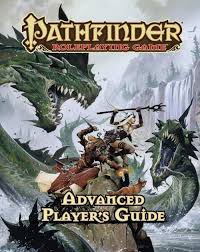
Review: Pathfinder Advanced Player's Guide

The Pathfinder Advanced Player's Guide is awesome.  Everything Paizo does seems to be awesome, and this book is no different.  Unlike 4th Edition's many extra Player's Handbooks, the Advanced Player's Guide adds to and expands the Pathfinder system, not just in adding more of the same kinds of options, but opening up all new options as well.

I want to keep these little reviews short and sweet, so I'm not going to go through everything that lies within this wondrous tome.  (Well, figuratively a tome - I got the PDF).  Rather, I would like to point out three things that are particularly good about the book, and also to discuss any flaws that I find in it.  Again, this won't be a thorough review, more like an impression.

First, the cool:

New Base Class: Alchemist
I really like that Alchemists are one of the new base classes presented by the Pathfinder Advanced Player's Guide.  They are in some ways the Paizo take on the 3.5 Artificer from the Eberron setting, but their focus is not on crafting magical items, but rather on producing alchemical items.

The most exciting application of this ability is creating grenade-like bombs which Alchemists throw in combat. They are walking with loads of potential chemical energy strapped to their backs and around their waists and in their pockets, and during combat, the Alchemist is mixing volatile chemicals on the fly and tossing them on her foes.  That's kind of cool.

Alchemists are also able to create mutagens which they can drink, Dr. Jeckyll style, to modify their abilities in a similar way to how transmutation spells like Fox's Cunning function.  As an Alchemist advances in level, she gets the chance to make Discoveries, improving her abilities, and there is even the Master Chymist Prestige Class, for those who really want to go over the top with their Jeckyll/Hyde issues.

A little note under an Alchemist's special abilities - they all receive the Throw Anything ability.  True, an Alchemist is pretty deadly armed with chemical bombs and mutagens, but I picture a fun scene with an Alchemist in a kitchen, hurling steak knives and pots of boiling water at her foes...

New Equipment
New weapons like the boar spear, sword cane, chakram and double crossbow make their debut in this book, as well as a number of new alchemical items and substances, which  makes a lot of sense with the new Alchemist class.  There is also some truly fantastic artwork depicting the various weapons and suits of armor - far more colorful and evocative than I've seen in other fantasy armories.

What really struck me, though, were the simple new pieces of adventuring gear.  Some things, like earplugs or a periscope, immediately make me wonder how I could build encounters around their use, or as a player, how I could abuse these things to gain an advantage in the game.  There are also items like the astrolabe, bear trap and compass that simply make sense, and can also be of obvious use to adventuring parties.

For those who are less than honest when they go down to the common room at the end of a hard days' dungeon-crawling, there are loaded dice and marked cards.  Overall, a lot of new cool stuff for the inevitable d20 shopping sprees at character creation and between adventurers.

New Prestige Class: Mastery Spy
It has always driven me a bit crazy that in almost all d20 systems, and in most gamist-simulationist combat-focused fantasy RPGs I've ever seen, there are heaps and piles of weaponry, racks of armor, and hundreds of combat abilities, as well as a plethora of magical spells that are aften solely useful in combat.  If I want to play a socially-focused character, a "face" so to speak, however, I'm just out of luck.  I'm going to wander, forlorn from encounter to encounter, making Diplomacy rolls and hoping that, at best, I might make some NPCs like me a little bit more.

Truly sad.

Enter the Master Spy, requiring a number of social skills at up to 7 ranks as well as the Deceitful and Iron Will Feats.  A Master Spy is going to be more socially powerful than other characters of her level, and will become a master of both disguise and deception, able to hide and even alter her alignment.  This is still a combat game, of course, so the Master Spy also periodically gets a bonus to sneak attack damage, and at higher levels, will get the assassin's death attack ability as well as the ability to entirely assume another persona at the highest level, allowing her to even fool the most powerful divination spells.

The problem remains that the Master Spy will not be as powerful or effective in combat as probably any other Prestige Class - that's just a fact of d20 in all of it's forms.  For a social-focused Rogue, however, or possibly a Bard, the Master Spy is a great choice, and I can see a game being built around an embedded Master Spy and her allies helping her from the outside, acting on the information she gathers.

Sneaky Fourth: Hero Points
Under New Rules, the Pathfinder Advanced Player's Guide introduces Hero Points.  These are very similar to my house rules of Action Points from the Eberron setting in 3.5.  Essentially, Hero Points give players more options, as well as some control over when things like character death happen.  I like this in particular because it gets rid of the 'meaningless death' issue in many fantasy RPGs - where the player fails one roll and her character plummets to her death, or is killed by the save-or-die spell, in a way that doesn't further the story whatsoever.  Screw that.

Flaws
A little artistic oversight - the swords on page 261 and 263 are being held in exactly the same way, almost like the artist was using the same sword-holding model for each painting.

Honestly, I am a serious fan of most of what Paizo does, but there aren't many flaws in this superb book.  Most of the 'flaws' I came up with were places where the book didn't go far enough, or where I wished they had included more of the great stuff they are serving up.

Conclusion

4 out of 5 vials of alchemical mutagen

Wednesday, December 1, 2010

2010 NaNoWriMo Reflection

I didn't finish.  I didn't "win" this year.  Not by a long shot.  I got to about 12,000 words and that was as good as I could do.

I can think of a number of reasons that I failed this year.  I had an idea for a story that was already derivative - it was an adaptation of someone else's setting.  Not really fanfic, but derivative enough that I couldn't send it off to publishers in the form it was taking.

It's also possible that I'm simply not a novelist, not a long-form storyteller.  I don't doubt that I'm a storyteller, I just seem to have trouble with novel-length stories.  When I won a few years ago, it was with a story that I thought was pretty cool.  I put this huge amount of November work into it, but then when NaNo was done, I dropped it entirely.  I didn't have the motivation to go back and edit the story.

Is that I'm not a novel writer, or is it that I haven't found the right novel to write?  I don't have any question about whether I am a writer - I write lots of things, not just this blog, and I do a pretty good job of it.  I just wonder whether novels are my thing; will ever be my thing.  I love reading them - there's that at least.

Next year, I'll try it again.  We'll see.  Might just be a matter of a lot of attempts.

Big, big congratulations to everyone who won this year.  See you all next year when I start again with page 1, word 1.

Friday, November 26, 2010

Review: D&D 4th Edition Dark Sun


This is a brief take after my reading of the new campaign setting for 4th Edition Dark Sun.  I have a lot more to say, but I'm trying to be succinct.  If you have particular questions, meet me in the comment thread.

A while ago I got a copy of Dark Sun for 4th Edtion.  I've recently finished reading the complete Prism Pentad for the first time, and might talk about those in another post.  Suffice to say - the quirkly illogic of old-school D&D combined with the brutality of the setting to make an interesting read all around.  Not all of the books are equally good (the 4th one is the worst of the lot, and I might even say skip it) but I read the whole five books, which says something.

I picked up the new 4th Edition Dark Sun Campaign Setting, wondering how 4th Edition's invincible player-characters would combine with the life-is-cheap brutality of Athas.  The answer: you get a lot of 4th Edition wedded to a tiny bit of Dark Sun.

As an implementation of the Dark Sun setting, I think that the new campaign book basically fails.  There is some text about how tough Athas is, but there is very little that actually makes it tough in terms of system.  You have to spend about 5gp a day to live, and if you don't,  you start losing healing surges from lack of water and so on.  Compare this to the most physically strong character in the books, Rkard the Mul, being laid low by having to walk out in the open for three or four days, reduced to a near-dead state, and Athas really loses it's bite.

What I wanted was a grim, desperate land where travel itself, usually at best handled by a montage or a couple skill challenge, could kill you just as readily as the overwhelming collection of murderous, psionic fauna.  What you get is a way to drain 5gp a day out of your pocket.  Which, when a first level encounter might net the party hundreds of gold pieces, has little to no sting.

More than anything else, 4th Edition's take on Dark Sun convinced me that the setting needs it's own system.  D&D is not about being murdered by your harsh environment. It is not about deceit and back-stabbing and political maneuvering.  Both of these things feature prominently in the Prism Pentad books.

Where Dark Sun and 4th Edition overlap in a sweet spot is in gladiatorial combat.  I could see a game based on a cadre of gladiators in Tyr going really well - you get the monster-of-the week phenomenon without needing a lot of explanation, and you get to showcase what 4th Edition does - small-scale tactical combat with kewl powerz.

Once you leave the gladiatorial arena, though, 4th Ed falls apart as an engine for Dark Sun stories.

Rating: 2.5 out of 5 shards of obsidian.

Tuesday, November 16, 2010

Pathfinder: New Spellcasting Feats

I've always thought that Augment Summoning was lonely, and I wanted to see other Feats linked to Spell focus in the other arcane schools.  So here we go - this is a rough sketch, feel free to take and adapt for yourselves:

Augment Dispel
Prerequisite: Spell focus (abjuration)
When making a d20 roll related to dispelling a magical effect, the caster can take 20.

Augment Scrying
Prerequisite: Spell focus (divination)
The duration of all divination spells is extended to concentration +2 rounds where that duration exceeds the listed duration.  For example, scrying lasts for 1 minute/level or concentration +2 rounds, whichever is longer.

Augment Charm
Prerequisite: Spell focus (enchantment)
Charm spells cast by a person with this Feat are more powerful than normal.  Opposed Charisma checks are not required except for the most extreme commands, and the subject of the charm spell will undertake dangerous actions which fall short of suicide.  Lastly, when the charm spell ends, the victim will not have a clear memory of having been magically coerced unless she succeeds at a will save at the spell's normal DC.

Augment Elementalism
Prerequisite: Spell focus (evocation)
Then caster chooses an element in which she specializes.  When she casts evocation spells with this element, the deals +1 damage per damage die rolled.  For example, a fire-specialized elementalist would deal 5d6+5 damage at 9th level when casting fireball.

Augment Figment
Prerequisite: Spell focus (illusion)
Illusionists who take this feat are able to create more persistent figments using spells like Silent Image or Major Image.  These illusions persist even after the caster ceases concentrating on them.  As long as a figment persists, however, the caster loses that spell slot until she dispels the illusion or it is dispelled with a successful will roll due to disbelief.

Augment Undead
Prerequisite: Spell focus (necromancy)
All undead created by a necromancer with this feat are affected as if they are on desecrated ground, including +1 to attack and damage rolls as well as saving throws.  These undead also receive +1 hit point per HD.

Augment Augmentation
Prerequisite: Spell focus (transmutation)
When the transmuter casts a spell which augments the ability of it's target, this bonus is raised by +2.  So, for example, Fox's Cunning increases Intelligence by +6.

Sunday, November 14, 2010

Scott Pilgrim vs the World is one of the worst movies I've ever seen


Here's what I had to say, in brief, about Scott Pilgrim vs the World: 


This was one of the worst movies I've ever seen in my entire life. It was like watching someone play a video game, only more boring. It was sometimes slightly clever. If only it had a story, or a single interesting character, or anything meaningful to say.


I don't remember feeling that detached from a movie in a very long time; possibly ever.  It was totally unengaging.  There's a feeling that I really enjoy, when a movie makes me feel as if I am outside myself, if only for an hour or two, during which it is an engrossing, immersive experience.  Even very bad films can make me feel this way if there is an engaging character, or even a really funny scene.  Anything.


I might have connected to Scott Pilgrim's character, if there was any character there to connect to. But he's kind of a confused-looking place-holder who trudges his way through what passes for a plot.


If there was something genuinely attractive about Ramona Flowers, that might have worked.  But there was hardly a flicker of life in her, but alas.  She was the MacGuffin, and an empty one at that. All I knew about her was that 1. her hair changes color frequently, 2. Scott Pilgrim likes her and 3. she has evil exes.  Nothing about her that wasn't on every promotional poster for the movie.


Where I really checked out, though, was the first battle with the first evil ex.  That was a scene that was so awful that I literally squirmed in my seat with embarrassment for the filmmakers.  I think the fight scene was supposed to resemble a Bollywood musical number.  I've watched a few Bollywood musical numbers, and this piece of tripe was a far cry from them.


There were occasional sight-gags, and I've never seen a movie that was presented in the same way, as an old-school style video-game with level-ups and coins bursting out of downed foes.  That was...slightly clever, I suppose.


But there was no world for Scott Pilgrim to inhabit.  One method would have been literalism - these supernatural music-fueled fights break out.  Another method would have been for the musical fights to be going on in Scott Pilgrim's imagination, with the humorous return to reality after the fact.  The filmmakers went for neither; God knows why.  Rather it was what I experienced as a miasma of imagery - and I mean that in the Dictionary.com sense.


Part of my disappointment was that the movie could have clearly been so much more.  It could have said something.  


It just didn't.


Or, more likely, it did, and I'm the only person I know who didn't get it.


Maybe the graphic novel is good.

Saturday, November 13, 2010

GURPS Midnight: Running A Big Fight in GURPS (Aftermath)

Image from Heroes of Battle, WotC

The Post-mortem

This is the follow-up to my post about setting up for a big tactical battle using modified GURPS rules...

In short, the player-characters kicked ass during the mass tactical combat.  They seemed to have fun and to be engaged in placing their various troops, which is cool because I know two of them aren't usually all that engaged in tactical combats.  They got a kick out of really giving the Orcs a beating.  When the Orcs realized things were going bad, one of the PCs nailed a roll to taunt them into fully attacking, and they were basically pinned down, surrounded, and then rushed by angry villagers who cut them to pieces.

The battle was still significant.  One PC took a javelin in the chest and went down in one hit, as did one of the named NPCs who had been with the PCs since the first session - she almost didn't recover, in fact.

One of the things I really like about GURPS is that having a javelin thrown at you is like "Oh shit!  A javelin!  I might die!"  Instead of D&D, where you might think "Oh, a javelin, 1d6 plus strength modifier damage.  I can eat ten of these, easy."

Anyway, overall, it was a complete success.  As always, in high-lethality tactical combat, planning is everything.

It was also pretty efficient.  A full-scale tactical fight, with combat modifiers for footing and cover and everything, was resolved in under 2 hours, with over 100 combatants and 11 different unit types.  That's quicker than a D&D 4th edition fight can be with a tenth that many participants.

I give the whole experience a B+.  Everyone was engaged, everyone had a thing to do, and the fight was quick and big and bloody.  Good times.